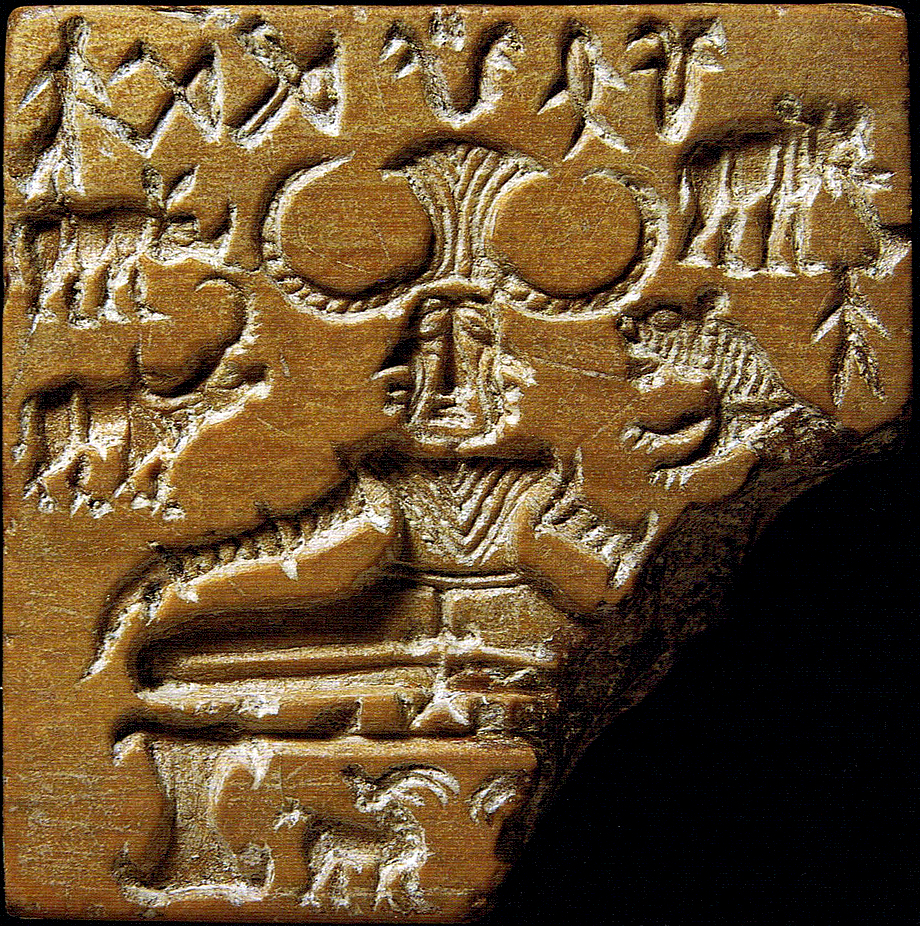
On 27 May 2026, the Indian Ministry of Culture posted on social media that the famous Pashupati seal of the Indus Valley Civilisation depicts the Hindu god Shiva — a seated figure in a yogic posture, horned, surrounded by animals, unmistakably evoking what would later be called Pashupati, Lord of Beasts. Historian Audrey Truschke responded with derision, calling the claim ahistorical and implying that such an identification was a projection of modern Hindu identity onto an unrelated ancient artefact. The exchange was sharp, brief, and symptomatic of a much larger debate — one that has been running for nearly two centuries and shows no signs of resolution.
This article is not primarily about the Pashupati seal, though it will return to it. It is about the wider question that the seal dispute illuminates: where did Sanskrit come from? Where did the Vedas come from? And what is the relationship between the Indus Valley Civilisation — that extraordinary urban achievement centred on what is today Pakistan and northwestern India — and the Vedic civilisation that followed it? The standard academic answer, which has hardened over decades into something approaching orthodoxy, is that there is no meaningful continuity: that Sanskrit and the Vedas arrived with migrating peoples from the Pontic-Caspian steppe, that they were foreign to the Indus Valley world, and that Indian civilisation as we know it is, in its deepest linguistic and religious roots, an import.
This article argues that the evidence, taken in its totality, does not support that conclusion — and that the certainty with which it is asserted reveals as much about the ideological history of the theory as about the archaeological and linguistic facts.
The Theory and Its History
The Aryan Migration Theory — or, in its harder earlier form, the Aryan Invasion Theory — has its origins in nineteenth-century European scholarship. When Max Müller and his contemporaries began the systematic study of Sanskrit in the early 1800s, they were struck by its structural similarity to Greek, Latin, Persian, and the Germanic languages. This observation, which was genuinely important and linguistically valid, led to the reconstruction of a Proto-Indo-European (PIE) language — a hypothetical ancestor tongue from which all these languages descended. The question that followed was: where did PIE originate, and how did it spread?
The answer that European scholars arrived at — shaped, it must be said, by the intellectual climate of the colonial era — was that PIE speakers had originated somewhere in Central Asia or the European steppe, and had spread outward in waves of migration or conquest, bringing their language and culture with them. When this framework was applied to India, it produced the AIT: a people calling themselves Aryans, Sanskrit-speaking, chariot-riding, and cattle-herding, had entered the Indian subcontinent from the northwest sometime around 1500 BCE, displacing or absorbing the earlier Indus Valley inhabitants, and had composed the Rigveda in their new homeland.
The theory was not without ideological convenience. For British colonial administrators, it provided a useful narrative: India's high culture was itself the product of an earlier invasion from outside, which naturalized the current one. For certain Indian reformers, it offered a way of distancing themselves from the caste system by attributing it to the Aryan newcomers. For European racial theorists — and here the history becomes genuinely dark — it provided a genealogy for an imagined Aryan master race. The AIT did not originate as a neutral scientific hypothesis. It originated in a specific historical moment with specific ideological pressures, and those pressures shaped its contours in ways that subsequent scholarship has not entirely escaped.
The Evidence for Steppe Origins — and Its Limits
It would be intellectually dishonest to dismiss the evidence for some form of migration from the steppe into South Asia in the late third and early second millennia BCE. That evidence exists and deserves serious engagement.
The most compelling recent evidence comes from archaeogenetics. Ancient DNA studies — particularly the landmark 2019 paper by David Reich and colleagues in Science — have identified a significant component of steppe ancestry in present-day South Asians, particularly in upper-caste populations and in populations of northern and northwestern India. This steppe ancestry, associated with the Yamnaya and related cultures, appears to have entered South Asia during the second millennium BCE. These are real findings by serious scientists using rigorous methodology.
The linguistic evidence is also real. Sanskrit belongs unambiguously to the Indo-European language family. Its structural relationship to Avestan, Greek, Latin, and the other IE languages is not a colonial construction — it is a demonstrable linguistic fact established through the comparative method. Some mechanism must account for the spread of IE languages across Eurasia, and population movement is the most plausible.
What the evidence does not support, however, is the specific narrative that has been built upon these foundations — a narrative that goes considerably beyond what the data actually establishes.
"The presence of steppe ancestry in South Asian genomes does not establish that Sanskrit and the Vedas came from the steppe. Genes and languages do not always travel together, and culture is not reducible to ancestry."
The presence of steppe ancestry in South Asian genomes does not establish that Sanskrit and the Vedas came from the steppe. Genes and languages do not always travel together, and culture is not reducible to ancestry. The question of what proportion of steppe ancestry is required to transmit a language — and under what social conditions — is not resolved by the genetic data alone. Nor does the genetic evidence establish the directionality of cultural influence with any precision. It establishes that there was population movement. It does not establish that the movers were the primary authors of Vedic civilisation.
The AASI Baseline and What It Tells Us
The same ancient DNA research that identified steppe ancestry in South Asians also identified something of equal or greater significance that has received far less popular attention: the Ancient Ancestral South Indian (AASI) component, which represents the deep indigenous ancestry of the subcontinent and has no meaningful parallel outside South Asia.
The AASI component is not a minor thread. It is the dominant ancestral strand across the subcontinent, present in all South Asian populations to varying degrees and entirely absent in steppe populations. When the full picture of South Asian genetic history is considered — AASI as the deep indigenous base, with later admixtures from Iranian agriculturalists and, much later, from steppe-related populations — what emerges is a picture of a subcontinent with an extraordinarily ancient, continuous, and fundamentally indigenous population history, into which outside influences arrived but did not replace.
This matters for the cultural question because it reframes what the steppe ancestry evidence actually tells us. The people who were present in the Indus Valley at the height of its civilisation — the builders of Mohenjo-daro and Harappa, the users of a script we still cannot read, the creators of the Pashupati seal — were predominantly of AASI and Iranian agriculturalist ancestry, with little or no steppe component. The steppe-related ancestry that appears later in the genetic record represents an admixture into this existing population — significant, but not a replacement.
The question, then, is not whether steppe-related people came to South Asia. Some evidently did. The question is whether they arrived as the primary bearers of Sanskrit and Vedic culture into a civilisationally empty or receptive space — or whether they arrived as one group among many into a subcontinent that already had its own sophisticated civilisational traditions, and were absorbed into and shaped by what they found there as much as they shaped it.
The Problem of the Gap — and the Saraswati
The standard AIT narrative requires a civilisational gap: the Indus Valley Civilisation declines around 1900 BCE, and the Vedic civilisation that follows is the product of the incoming Aryans. The two are discontinuous — different peoples, different languages, different religions.
This narrative faces a serious problem that is rarely acknowledged in popular accounts of the theory: there is no gap. The archaeological record shows no mass destruction, no sudden cultural rupture, no evidence of the kind of large-scale displacement that an invasion or even a rapid migration of culturally dominant newcomers would be expected to leave. The decline of the major Indus urban centres was gradual, multi-causal, and almost certainly linked in significant part to the drying of the Ghaggar-Hakra river system — the river that many scholars identify with the Saraswati of the Rigveda.
This identification is significant. The Rigveda describes the Saraswati as a mighty river, mightier than all other rivers, flowing from the mountains to the sea — a description that fits the reconstructed Ghaggar-Hakra precisely and fits no river in Central Asia or the steppe at all. If the composers of the Rigveda were describing a river they had recently arrived beside, they were describing one that flowed through what is today Haryana, Rajasthan, and Pakistan — the heartland of the Indus Valley Civilisation. The geography of the Rigveda places its composers inside the subcontinent, not arriving into it.
The drying of the Saraswati-Ghaggar system, now confirmed by satellite imagery and geological studies, caused a major eastward population shift — from the Indus-Saraswati region toward the Gangetic plain. This is visible in the archaeological record as a dispersal of Indus-related cultures, not as a replacement by newcomers. The people moved. Their traditions moved with them. What followed in the Gangetic plain — what we call the Vedic period — was not a new civilisation imported from outside but a transformed continuation of what had come before.
B.B. Lal and the Archaeological Continuity
No scholar has done more to document the archaeological continuity between the Indus Valley and later Indian civilisation than B.B. Lal, former Director General of the Archaeological Survey of India. His decades of fieldwork, particularly at sites in the Painted Grey Ware and Ochre Coloured Pottery traditions that bridge the Indus and Vedic periods, produced evidence that the two civilisational phases were not separated by a clean break but connected by continuous habitation, shared material culture, and overlapping traditions.
Lal's work on fire altars — structures at Indus sites at Kalibangan that closely resemble the Vedic fire altars described in the Shatapatha Brahmana — is particularly significant. The Vedic ritual of the fire altar (agnikunda) is one of the most ancient and distinctive elements of the Vedic tradition. Finding structures that match its description at Indus Valley sites predating the supposed Aryan arrival is not proof of continuity, but it is precisely the kind of evidence that the discontinuity narrative struggles to explain.
Lal's conclusions — that the Indus Valley Civilisation was the archaeological expression of a Vedic or proto-Vedic culture, and that the two formed parts of a single continuous tradition — have been contested, sometimes fiercely, by scholars committed to the AIT framework. But the contestation has not always engaged with the archaeological evidence on its own terms. Much of it has proceeded by asserting the conclusions of the linguistic and genetic arguments as if they settled the archaeological question, when in fact each strand of evidence needs to be evaluated independently.
Talageri and the Linguistic Argument
On the linguistic front, Shrikant Talageri has made the most systematic case for what is sometimes called the Out of India Theory (OIT) — the position that the Indo-European language family originated within the Indian subcontinent and spread outward, rather than entering from outside. Talageri's work, particularly his analyses of the internal chronology of the Rigveda, argues that the oldest books of the Rigveda show no knowledge of a northwestern homeland, no memory of a migration into India, and that the geographical references within the text point consistently to a subcontinent-internal origin.
Talageri's work is not without controversy, and the OIT remains a minority position among professional linguists. The mainstream reconstruction of Proto-Indo-European — its vocabulary, its likely ecological setting, its reconstructed cultural world — does not map neatly onto the Indian subcontinent. The horse, the wheel, the chariot, the specific flora and fauna embedded in PIE reconstructions all point more plausibly to a steppe or temperate Eurasian homeland than to the Indian subcontinent.
But the important point is not whether the OIT is correct in every detail. The important point is that Talageri and others have demonstrated that the linguistic evidence is considerably less determinative than its proponents claim. The question of PIE origins is genuinely open — the Anatolian hypothesis, the steppe hypothesis, and various modified versions of each are all actively debated among specialists — and the certainty with which popular accounts of the AIT treat the linguistic question as settled is not warranted by the actual state of the field.
What is not seriously contested is that the Vedic Sanskrit of the Rigveda shows signs of being composed by people thoroughly at home in the northwestern subcontinent — familiar with its rivers, its seasons, its flora, its geography. It does not read like the literature of a people recently arrived from elsewhere and describing a new homeland for the first time. It reads like the literature of a people describing the world they have always known.
The Pashupati Seal Revisited
Return now to the Pashupati seal — that small steatite object, measuring barely 3.5 centimetres, excavated at Mohenjo-daro in 1928 by John Marshall and named by him after the Vedic epithet of Shiva. The figure depicted is seated in what appears to be a yogic posture — legs crossed, heels together, feet projecting beyond the edges of a low throne. The figure is ithyphallic, wearing a headdress of horns, and surrounded by four animals: an elephant, a tiger, a rhinoceros, and a buffalo, with two deer beneath the throne.
When Audrey Truschke dismisses the identification of this figure with Shiva as ahistorical, she is making a claim that requires the strict discontinuity of Indus and Vedic traditions to be true. If the two traditions are continuous — if the people of the Indus Valley and the composers of the Vedas are in meaningful cultural relationship — then the identification is not ahistorical at all. It is the natural recognition of a continuous iconographic and religious tradition.
"The figure in the Pashupati seal sits in the same yogic posture that will be attributed to Shiva across three millennia of Indian art. The animals surrounding him echo the Pashupati epithet — Lord of Beasts — that is among Shiva's oldest names."
The figure sits in the same yogic posture that will be attributed to Shiva across three millennia of Indian art. The animals surrounding him echo the Pashupati epithet — Lord of Beasts — that is among Shiva's oldest names. The ithyphallic iconography connects to the linga tradition that is central to Shaiva worship. The horned headdress echoes representations of Shiva across the subsequent tradition. None of these connections proves identity. But they constitute precisely the kind of evidence of continuity that the discontinuity narrative requires us to explain away.
To say, as Truschke effectively does, that these connections are mere projection — that modern Hindus are reading their own religion into an unrelated ancient artefact — is not a neutral scholarly observation. It is a specific theoretical commitment to the discontinuity of Indian civilisation, dressed as empirical caution. The equally valid empirical position is that a tradition so old and so continuous as the one that produced both the Pashupati seal and the living Shaiva tradition has every right to recognise itself across that span of time.
The Politics of Origins
It would be naive to discuss this debate without acknowledging its political dimensions — not because that acknowledgement resolves the scholarly questions, but because those dimensions explain why the debate generates such heat.
The AIT, in its various formulations, has served and continues to serve specific ideological functions. In the colonial period, it naturalised the idea of India as a land perpetually subject to civilising invasions from outside. In the post-independence period, it provided ammunition for those who wished to argue that Hinduism's foundational texts were the literature of oppressive foreign conquerors rather than the inheritance of all Indians. In contemporary academic culture, it has become associated with a progressive critique of Hindu nationalism, such that challenging the theory is frequently treated not as a scholarly position but as a political one — as if only Hindu nationalists could possibly have reasons to question the steppe-origin narrative.
This conflation is intellectually disastrous. The question of where Sanskrit came from and whether the Indus Valley and Vedic civilisations are continuous is an empirical question, answerable in principle by evidence. It is not made more or less true by the political affiliations of those who ask it. The fact that Hindu nationalists find the native-origin theory congenial does not make the native-origin theory wrong, any more than the fact that colonial administrators found the AIT congenial made it right.
What is needed — and what the Pashupati seal controversy illustrates the absence of — is scholarship willing to follow the evidence wherever it leads, unintimidated by the political valence that has been attached to particular conclusions. That is a high standard. It is also the only one worth meeting.
Continuity Is Not Purity
One final point deserves emphasis, because it is frequently missed by both sides of this debate.
To argue for the continuity of Indian civilisation — from the Indus Valley through the Vedic period to the present — is not to argue for the purity or isolation of that civilisation. Peoples moved, in both directions, across the northwestern passes and the ocean routes and the overland tracks that connected South Asia to the wider world. There was almost certainly movement of people from the steppe into South Asia in the second millennium BCE. There was movement of people, languages, and ideas from South Asia outward. The subcontinent has never been sealed from the world, and no serious argument for native civilisational origins claims that it was.
What is being argued is something more specific and more defensible: that the civilisational tradition we can trace from the Indus Valley seals through the Vedic hymns to the living practices of contemporary Hinduism represents a continuous indigenous development, shaped by but not created by whatever came from outside. That Sanskrit, whatever its ultimate linguistic genealogy, was developed and elaborated within the subcontinent by people who were overwhelmingly of indigenous ancestry. That the Vedas were composed by people who knew the rivers of Punjab and the seasons of the northwest as intimately as any people can know a landscape they have inhabited for generations.
Pakistan was part of ancient India. Mohenjo-daro and Harappa were not foreign cities on the edge of the Indian world — they were its heart. The Indus is not a river that flows through someone else's history. It flows through ours.
The river was never interrupted. It changed course, as rivers do. It absorbed new tributaries. But it flowed on — and it flows still.
Footnotes and Further Reading
1 John Marshall, Mohenjo-daro and the Indus Civilisation (London: Arthur Probsthain, 1931). Marshall's original identification of the Pashupati seal figure and his naming of it remain the starting point for all subsequent discussion.
2 David Reich et al., "The Genomic Formation of South and Central Asia," Science 365 (2019). The key ancient DNA study establishing both steppe ancestry and the deep AASI baseline in South Asian populations.
3 Vagheesh M. Narasimhan et al., "The formation of human populations in South and Central Asia," Science 365 (2019). Companion study with detailed analysis of AASI ancestry and its antiquity.
4 B.B. Lal, The Rigvedic People: 'Invaders'? / 'Immigrants'? or Indigenous? (New Delhi: Aryan Books International, 2015). Lal's comprehensive summary of the archaeological case for continuity, including the Kalibangan fire altar evidence.
5 Shrikant Talageri, The Rigveda: A Historical Analysis (New Delhi: Aditya Prakashan, 2000). The most systematic linguistic argument for an indigenous origin of Vedic Sanskrit, analysed through the internal chronology of the Rigveda's ten books.
6 Michel Danino, The Lost River: On the Trail of the Saraswati (Penguin Books India, 2010). The definitive popular account of the Ghaggar-Hakra / Saraswati identification, drawing on satellite imagery, geological surveys, and literary evidence.
7 Edwin Bryant, The Quest for the Origins of Vedic Culture: The Indo-Aryan Migration Debate (Oxford University Press, 2001). The most balanced academic survey of both sides of the debate, essential for understanding the full range of scholarly positions.
8 David W. Anthony, The Horse, the Wheel, and Language (Princeton University Press, 2007). The leading scholarly case for the Pontic-Caspian steppe homeland of Proto-Indo-European, presented rigorously and engaging with the South Asian evidence.
