There is a standard story told about the Smarta tradition, repeated across encyclopedias, comparative religion textbooks, and casual conversation alike. It goes roughly like this: Hinduism, over time, split into increasingly rival devotional camps — Vaishnavas devoted to Vishnu as supreme, Shaivas devoted to Shiva as supreme, Shaktas devoted to the Goddess as supreme, each camp increasingly convinced of its own deity's exclusive primacy. Into this fracturing landscape stepped a brilliant philosopher-reformer, who, seeing the social and doctrinal damage sectarian rivalry was doing, proposed an elegant compromise: worship all five major deities together, as equal manifestations of one underlying reality, and let each household choose its own preferred face for that reality without needing to declare the others false. On this telling, Smartism is essentially a diplomatic settlement — a clever, later solution imposed on top of an already-fractured religious landscape.
This essay argues that story has the history backwards. The unity was not invented to solve the rivalry. The unity came first, is older than any of the rival camps it supposedly reconciles, and what Smartism actually did was restore and re-systematize something the tradition already possessed at its very oldest layer — not broker a peace between positions that had never needed brokering in the way the popular story assumes.
Part One: The Standard Story, Stated Fairly
Before arguing against it, the standard account deserves to be stated in its strongest form, because it is not a foolish one. Multiple serious sources describe Shankara's systematization of five-deity household worship as a direct response to sectarian friction — an attempt to "streamline" Hindu practice, to reduce doctrinal conflict between competing devotional schools, to give ordinary households a way to honor the whole pantheon without having to adjudicate which single deity truly deserved supremacy. Some accounts go further, describing the effort as also aimed at moving Hindu practice away from certain older ritual customs increasingly criticized from outside the tradition, packaging both a doctrinal and a social motive into the same reforming gesture. This is a real, widely held scholarly characterization, and it is not unreasonable on its face: devotional intensity toward a single chosen deity, taken to its natural conclusion, does tend to generate real friction with devotional intensity toward a different deity, and a household or a teacher looking to reduce that friction might well reach for exactly the kind of five-fold arrangement this tradition is known for.
Part Two: What the Ground Actually Remembers
Here is where the standard story runs into a problem it does not adequately address. The five-deity worship arrangement Shankara is credited with popularizing does not first appear during his own lifetime. Archaeological evidence — actual excavated shrine sets, actual dated temple arrangements — shows this exact five-fold worship pattern in active use long before he was born, stretching back through the Gupta period and further still, into artifacts confidently dated to an era well before the common scholarly window for his own life even begins. A five-deity shrine set uncovered near Ajmer belongs to an imperial period predating him by a span measured in centuries, not decades.
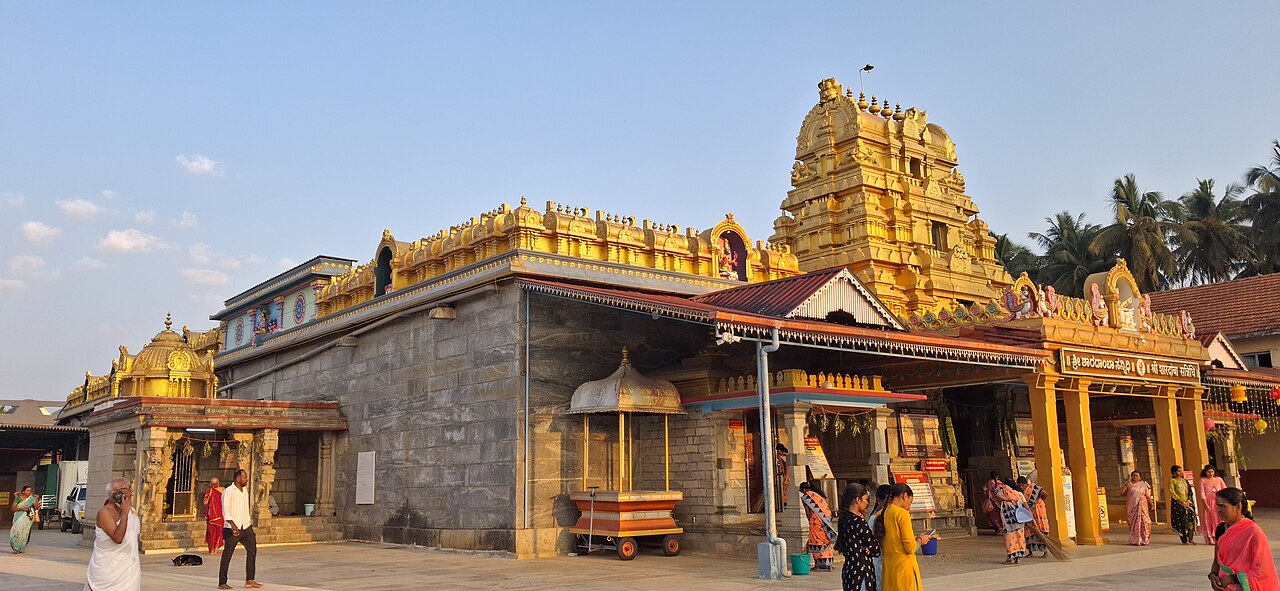
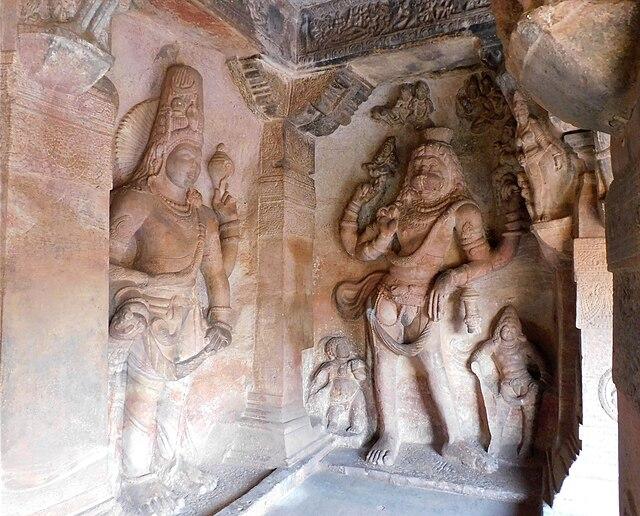
The evidence is not limited to shrine arrangements alone. Composite icons combining two deities into a single image — most famously Harihara, half Shiva and half Vishnu carved as one continuous figure — appear across the same early period, giving physical, sculptural form to the identical principle the archaeological shrine sets already suggest: that the boundary between these deities was never treated, at the level of actual religious practice, as an absolute metaphysical wall. A single stone image showing Shiva's and Vishnu's forms merging seamlessly into one body is a much more direct statement of non-exclusivity than any later philosophical argument could make in words, and these images predate the fully articulated philosophical defense of the same principle by a considerable margin. Major temple complexes across the breadth of the subcontinent, from Odisha to Karnataka to Kashmir, embed this same five-shrine or composite-icon arrangement into their basic architecture as an unremarkable, standard feature — not as a novel accommodation but as the ordinary, expected shape a serious temple complex was assumed to take.
This changes the shape of the whole question. If the practice already existed, in recognizable form, for centuries before Shankara's own systematic work, then he did not invent it to solve a problem that had only just become acute in his own generation. He inherited an already-old practice and gave it the rigorous philosophical architecture — the technical vocabulary of Saguna and Nirguna Brahman, the doctrine of nama-rupa, the reasoned case for why no single deity-form deserves privileged status — that transformed a widespread devotional custom into a fully articulated philosophical position. The systematization was his. The underlying practice, and very plausibly the underlying intuition behind it, was not.
Part Three: The Oldest Testimony
Push further back, past even the archaeological record of shrine arrangements, to the oldest surviving layer of the textual tradition itself, and the same principle appears already stated outright, in words, rather than merely implied by an arrangement of icons. The Rig Veda — the most ancient stratum of the entire corpus, older than every other text this essay will discuss, older by a wide and undisputed margin than any of the sectarian systems it is sometimes claimed to reconcile — contains one of the most quoted lines in the whole tradition:
इन्द्रं मित्रं वरुणमग्निमाहुरथो दिव्यः स सुपर्णो गरुत्मान्।
एकं सद्विप्रा बहुधा वदन्त्यग्निं यमं मातरिश्वानमाहुः।।
Indraṃ mitraṃ varuṇamagnimāhuratho divyaḥ sa suparṇo garutmān.
Ekaṃ sad viprā bahudhā vadanty agniṃ yamaṃ mātariśvānamāhuḥ.
"They call it Indra, Mitra, Varuna, Agni... That which is One, the wise speak of in many ways — they call it Agni, Yama, Matarishvan." (Rig Veda 1.164.46)
This is not a philosopher's later gloss retrofitted onto an originally polytheistic religion to make it look more sophisticated in hindsight. It is a claim made within the oldest textual witness the tradition possesses, stating in plain terms that the various named powers being invoked in that very same corpus of hymns are alternate designations for a single reality behind them all. One clarification matters here, precisely because it is easy to get wrong: that single reality is not one more God standing behind the others, a formless Ishvara for which Indra, Agni, and Varuna would simply be costumes. As established elsewhere in this series, even a bare, formless conception of a supreme creator is still Saguna, still a nama-rupa in its own right, not the unconditioned reality itself. What the verse actually points toward is Nirguna Brahman — the reality beyond the entire category of Godhood, form and formlessness alike, of which Indra, Agni, Varuna, and every Ishvara-concept that later ages would construct are equally instances of naming. The "many names, one truth" insight is not a late philosophical refinement, and it is not a subtler monotheism dressed in older vocabulary. It is present at the very beginning of the written record, before any of the devotional schools this essay is discussing had yet taken the specific, organized, competing shape in which later ages would come to know them.
The verse's own two halves, read carefully, are doing two different jobs rather than simply restating the same point twice. Ekam sat, "truth is one," names the paramarthika fact itself. Viprah bahudha vadanti, "the wise call it variously," describes something that happens at the vyavaharika level as a consequence — and the wise are not reporting a preference or a stylistic choice when they reach for many names. They have no alternative. Language works by attribution and relation: every word draws a boundary, places its object in a network of comparisons, picks something out from something else. Nirguna Brahman, being without a second, has no boundary for any word to find purchase on. One name would already claim a precision no name could actually deliver. Many names, each pointing without quite arriving, is not a failure of the wise to agree on a single term — it is the only honest way language can behave once it is aimed at something naming was never built to hold.
This is not an isolated verse, either, standing alone against an otherwise straightforwardly polytheistic backdrop. The same corpus contains the Nasadiya Sukta, the celebrated hymn of creation, which turns its skepticism inward on the gods themselves — asking who truly knows the origin of existence, and suggesting that even the gods came after creation and so cannot testify to what preceded them. A textual tradition capable of that degree of reflective distance from its own pantheon, at its very oldest layer, was never a simple, uncomplicated multiplicity of independent, rival powers in the way the popular imagination of ancient polytheism often assumes. What it reached for, even here, was not a bigger, better, formless deity to replace the named ones — it was already gesturing past the entire category Godhood belongs to. That instinct, aimed at something prior to every name and every form a name could take, was present from the beginning, not something later philosophy had to import from outside to correct an earlier, cruder stage of belief.
Part Four: What Actually Came Later
Now place next to this the systems that get casually described as Shankara's sectarian "rivals" — the ones his compromise is supposedly designed to sit between. The fully exclusive philosophical architectures that fix the identity of the supreme reality doctrinally to one specific deity, ruling out the others not merely as a matter of personal devotional preference but as a matter of settled metaphysics, do not emerge until generations after Shankara's own systematic work was already complete. Ramanuja's Vishishtadvaita, which identifies ultimate reality inseparably with Vishnu-Narayana specifically, and Madhva's Dvaita, which builds an entire graded hierarchy of being with Vishnu alone fully independent at its summit, both belong to a considerably later wave of philosophical system-building — arriving only after the five-deity, many-names framework had already been standing, in both practice and now in rigorous philosophical form, for a very long time.
It is worth being precise about what actually changed when these later systems arrived, since the difference is not that they introduced devotion to a specific deity — that had, as the next section will discuss, genuinely old roots of its own. What changed was the construction of an entire metaphysical architecture that made a single deity's supremacy a matter of settled doctrine rather than personal or lineage-based devotional preference: the systematic ranking of other deities as ontologically dependent, the closing off of the question of ultimate reality's identity to a single name in a way the many-names framework had never attempted. That specific move — doctrine, not devotion, hardened into metaphysical exclusivity — is the later arrival.
This ordering matters enormously for how the whole story should be told. The philosopher credited with systematizing the five-deity approach was not standing between two already-fixed, already-warring exclusive camps, brokering a truce acceptable to both. The fully exclusive camps his tradition is imagined to be mediating between mostly did not yet exist in their mature, doctrinally rigid form when he did his work. If anything, the causal arrow runs the other way: the later exclusive systems arrived into a landscape where the older, wider vision was already the established, philosophically articulated position, and it was those later systems that made the newer, narrower move — not the many-names tradition reacting defensively to sectarian pressure that had not yet fully formed.
Part Five: Restoration, Not Invention
Put the three pieces together — the oldest textual witness already stating the many-names principle in plain words, the archaeological record showing the corresponding worship practice in place centuries before Shankara's own era, and the fully exclusive rival systems only crystallizing generations after his work was already finished — and the standard story becomes very difficult to sustain in its usual form. This was not a peace treaty between exhausted factions. It was the deliberate recovery and rigorous re-articulation of the oldest available position in the entire tradition, using the philosophical tools of a later age to say, with full systematic force, something the earliest hymns had already said in a single verse.
There is a further piece of evidence worth adding here, sitting in plain view in the name of the tradition itself. The word used for this whole family of practice and belief — Smarta — derives from smriti, "that which is remembered," the category of tradition distinguished from shruti, "that which is directly heard" or revealed, referring to the Vedic corpus itself. A Smarta, by the plain meaning of the word, is one who remembers — one whose religious identity is explicitly built around continuity with what came before, not around a new doctrinal innovation bearing a founder's personal stamp. Even the tradition's own self-chosen name describes an act of retention and recall, not invention.
Part Six: The Widening, Not the Narrowing
The pattern this essay has been tracing did not stop with five deities, and the way it continued to grow is itself instructive. Later tradition expanded the original five-fold arrangement into a six-fold one, adding Skanda — known in the south as Murugan, Tamil Kadavul, the god who is himself Tamil — alongside Shiva, Vishnu, Devi, Ganesha, and Surya. This expansion, called Shanmata, moves in exactly the opposite direction from what the "compromise between rivals" story would predict. A negotiated truce between exhausted factions tends to freeze at whatever number of parties actually needed to be placated in the room at the time; it does not keep expanding generations later to include a deity whose cult was, by any reasonable account, of more regional and more recent prominence than the other five. A living principle capable of continuing to recognize new names for what Part Three already identified as beyond every name, long after the original arrangement was set, behaves differently — it keeps doing the same work it always did, because the work was never really about managing five specific rivals in the first place. It was about a principle general enough to keep absorbing new instances indefinitely, precisely because the principle itself, stated once in the oldest hymns, was never actually about the number five.
Part Seven: The Honest Complication
It would be dishonest, and inconsistent with how this whole series has tried to handle its own claims, to let this argument stand without its necessary complication. Devotional intensity toward specific, individually named deities — the emotional and ritual seed of what would later become fully exclusive sectarian systems — does not begin only after Shankara's own era, waiting politely for Ramanuja and Madhva to arrive and formalize it. Devotion to particular divine figures, sometimes with real intensity, has its own genuinely ancient roots, running in parallel with the many-names vision rather than trailing meekly behind it. The honest picture is not a clean sequence where unity reigned unchallenged for millennia and then sectarian rivalry appeared out of nowhere in one later century. Both threads — the wide, many-names vision and the intense, particular devotion to one chosen face of the divine — appear to run alongside each other for a very long stretch of the tradition's history.
What is specifically and defensibly later is not devotional intensity itself, but its hardening into an exclusive philosophical claim — the specific move of building a rigorous metaphysical system that doctrinally forecloses the other deities' claim to ultimacy, rather than simply preferring one deity devotionally while leaving the metaphysical question open. That harder, more totalizing move is the one that arrives later, after the many-names framework had already received its most rigorous philosophical defense. The essay's claim is precise on this point, not sweeping: not "devotion is late," but "exclusive doctrine is late" — and it is this second, narrower claim that the evidence actually supports.
There is also a live, unresolved question sitting underneath this entire essay that deserves to be named rather than quietly assumed away: Shankara's own dates remain a genuine subject of dispute even within his own tradition, and the disagreement is more tangled than a simple split between insiders and outside scholars. Different mathas within the same Advaita lineage do not agree with each other — some placing him many centuries earlier than the dating most widely used in comparative scholarship, while at least one other major matha in the same lineage accepts a dating much closer to the mainstream scholarly window. This essay has deliberately avoided taking a position on that dispute, using relative rather than absolute chronology throughout, because the argument being made here — that the many-names vision precedes the fully exclusive systems that supposedly necessitated it — holds under either dating convention. If anything, a considerably earlier date for Shankara's own life would only widen the gap this essay is describing, not narrow it.
One argument sometimes raised in favor of an earlier dating deserves a fair, direct hearing rather than a dismissal: Shankara's surviving philosophical corpus contains no mention whatsoever of Islam, already established as a permanent political and religious presence on the subcontinent's northwestern frontier for the better part of a century, on the conventional dating, by the time of his birth. Complete silence about a permanently settled, expansionist, image-rejecting new religion, across an entire career otherwise built on identifying and refuting every rival system he encountered, is a genuine oddity worth sitting with rather than waving away. The strongest response available is that his surviving works belong to a specific genre — commentary on existing Sanskrit philosophical texts, in conversation with an already-established Sanskrit discourse community — and that community had not yet, in this period, developed a shared vocabulary for engaging Islam on its own terms; the same silence, notably, persists across a wide range of other Sanskrit philosophical literature confidently dated well after any possible version of Shankara's own lifetime, suggesting a pattern belonging to the genre rather than to this one figure's particular date. Neither side of this argument is decisive on its own. It is a genuine, open question, not a settled one, and it is more honest to say so than to pretend otherwise.
Conclusion: The Return, Not the Compromise
The popular image of a wise reformer stepping between warring sectarian armies to broker an elegant truce is a compelling story, but it is not the one the actual evidence supports. The many-names vision was not a later invention designed to manage a conflict that predated it. It is the oldest position the tradition has on record, older than the archaeological evidence for the practice built around it, older by a wide margin than the fully exclusive systems it is imagined to be reconciling. What looks, from the outside, like a diplomatic compromise between rival gods is better understood as a return — a deliberate act of remembering, by a tradition whose very name means exactly that, of a truth it had already spoken, in its own oldest words, long before anyone thought there was a quarrel left to settle.
The wise did not need to be taught that truth wears many names. They said so first. Everything since has either remembered that, or forgotten it.