A teacher who has spent forty years inside Advaita Vedanta will tell you, without much hesitation, that moksha is not an achievement. Nothing is produced, nothing is added, nothing is reached that was not already the case. And in the very next sentence, the same teacher will urge you toward moksha — will speak of crossing over, of breaking free, of the long and difficult road out of samsara — using every grammatical resource a goal-directed sentence has to offer. Ask them to reconcile the two and most will not even pause: yes, they will say, both things are true. This is not evasion. It is one of the more carefully engineered features of the tradition, and it survives sustained philosophical pressure rather better than it first appears to.
This essay takes the apparent contradiction seriously rather than resolving it too quickly. The technical doctrine is stated plainly in Part One. The deliberate strangeness of the language built to carry it is examined in Part Two. Part Three shows the same paradox operating even earlier, in the very desire that gets a student to the teaching in the first place. Part Four asks whether language could ever have said any of this more cleanly, and concludes it could not. Part Five sets out the two-stage method the tradition actually uses to teach something that cannot be taught directly. Part Six tells the story the tradition tells itself to explain why the method takes the shape it does. Part Seven explains why skipping the method is treated as a real failure, not an acceptable shortcut for the philosophically confident.
Part One: The Technical Claim
Advaita Vedanta sorts effects into two classes, and the distinction is not a minor scholastic nicety — it is the hinge the entire soteriology turns on. Something is sadhya, "to be accomplished," when it comes into existence through action: a pot did not exist, a potter acts, a pot now exists. Something is nitya-siddha, "eternally accomplished," when it was never not the case, full stop, regardless of what anyone does. Brahman, and the self's identity with Brahman, is classified in the second category without qualification.
Shankara's argument for this classification is more austere than it might sound. Anything produced by action inherits the nature of action: it begins in time, and what begins in time can end in time. This is why he refuses any teaching that treats moksha as jointly achieved through ritual action and knowledge combined (jnana-karma-samuccaya) — not on some sentimental preference for knowledge over ritual, but on a strict metaphysical ground. If liberation were an effect of action, it would necessarily be impermanent, since every effect that action produces eventually decays. A liberation that could wear off would not be liberation in any sense worth wanting. So the self's real nature has to be something that action cannot touch at all — not because action is too weak to reach it, but because it was never the kind of thing action produces in the first place.
What removes the ignorance, then, is not a technique of production but a correction of perception — knowledge (jnana) rather than ritual, and even jnana is only called a "means" to liberation in a qualified sense, since it does not manufacture anything. It removes a mistake. This is the entire technical position, and by itself it is coherent, even elegant. The trouble starts the moment the position needs to be taught.
Part Two: The Oxymoron Announced
Vedanta texts do not paper over the strangeness of describing an eternally-accomplished fact as something one "attains." They name it. The paradox is sometimes phrased directly as prāptasya prāptiḥ — the attainment of what is already attained — a construction built to sound almost like a category error, because in a sense it is one, deliberately preserved rather than smoothed away.
Compare this to how the tradition talks about ordinary attainment. You attain a job you did not have. You attain a degree you had not earned. In every ordinary case, "attainment" names a gap closing — a before-state lacking something, an after-state possessing it. Prāptasya prāptiḥ names something else: a gap that was never actually there, described using the exact vocabulary built for closing gaps. The tradition is not confused about this. It is pointing directly at the seam where ordinary language runs out, precisely because there is no other vocabulary available for what happens when a mistake about one's own identity gives way to accurate seeing.
Part Three: The Desire That Undoes Itself
Before language even becomes the problem, desire already is. Shankara lists four qualifications a student needs before Vedantic teaching can do any real work, and he calls the last of them the most important by far: mumukshutva, the burning desire for liberation, not a passing curiosity but an intensity that outweighs every competing want. And yet liberation, on the tradition's own account, is not a future state this desire is reaching toward. It is the student's actual, present nature, right now, misperceived. Which raises an uncomfortable question the tradition asks of itself directly: how can anyone desire what they already, in full, are?
Desire ordinarily requires a gap — you want the sandalwood's smell because you remember it and do not currently have it; you want the coming meal because hunger names an absence. But nothing can be desired that has never in some sense been tasted, which is itself an old Vedantic observation: desire always presupposes some prior acquaintance with its object, however dim. So what is mumukshutva actually a desire for, if not for a new state?
The tradition's answer is that mumukshutva is not desire for Brahman as an object still to be acquired. It is closer to a dawning intuition, not yet clear, that the self's own felt incompleteness is itself the mistake — an intuition strong enough to generate real longing before the longing's actual object has been correctly identified. The burning desire is not for something absent. It is the earliest stirring of suspicion that the absence itself might be false, a suspicion that has not yet matured into the clear seeing that would dissolve it. Mumukshutva, in other words, already carries the same structure this whole essay has been describing: a goal-shaped feeling, sincerely and even urgently felt, whose entire function is to motivate a process that ends not in reaching the goal but in recognising there never was a distance to close. The problem this essay opened with is not confined to how teachers talk. It is present at the very first qualification a student needs even to begin.
Part Four: Why Language Cannot Say It Cleanly
There is a reason this problem cannot simply be solved by more careful phrasing, and the reason is structural rather than a failure of any particular teacher's precision. The grammarian-philosopher Bhartrihari, whose Vakyapadiya remains foundational to how the tradition thinks about language itself, treats sentence-meaning as inseparable from the grammatical relations of agent, action, and object (karaka theory) — a sentence means by distributing a doer, a doing, and a thing done, and Sanskrit grammar, like most grammar, simply has no fully agent-free way of asserting that something is the case.
Say "the self is free" and the copula still stages a subject receiving a predicate, a thing described as being some way it was not necessarily understood to be a moment before the sentence was uttered. Say "there is nothing to attain" and you have produced a sentence whose entire rhetorical force depends on the listener first imagining attainment, then watching it get negated — the negation cannot arrive without the thing negated first being staged as a live possibility. Even the great Upanishadic declaration tat tvam asi, "that thou art," identifying the individual self with Brahman in the flattest possible terms, is still a sentence with a grammatical subject being told something about itself, a structure that cannot help but sound like information being delivered about a change in status.
This is not a defect in how any particular Vedantin phrases things. It is a limit built into the instrument. Language transacts in states, changes, and predicates because that is what ordinary experience (vyavahara) is made of, and the tradition's own texts are candid that scripture itself operates within vyavahara even while pointing past it. If the deepest claim genuinely cannot be stated without staging an agent, a change, and a goal, then goal-language is not a corruption of the teaching. It is the price of teaching in language at all.
Part Five: The Method Built for This Exact Problem
Given that language cannot avoid staging goals, states, and agents, the tradition developed an explicit two-stage method for using this limitation rather than being defeated by it. Shankara names the method directly in his commentary on the Bhagavad Gita, quoting what he calls the established saying of those versed in the teaching tradition:
अध्यारोपापवादाभ्यां निष्प्रपञ्चं प्रपञ्च्यते।
Adhyāropāpavādābhyāṃ niṣprapañcaṃ prapañcyate.
"That which is free of multiplicity is explained by means of superimposition and its subsequent negation." (Shankara, Bhagavad Gita Bhashya, on 13.13, quoting a traditional formula)
Adhyaropa is the deliberate, provisional grant of a false attribute or framework, made because the student's actual position requires a starting point they can genuinely stand on. Apavada is the later, equally deliberate withdrawal of exactly that framework, once it has done its work. The method is not a concession to weaker students who cannot yet handle the full truth, held out with the intention of eventually being corrected in embarrassment. It is closer to scaffolding erected around a building precisely because the building cannot be raised without it, and precisely because scaffolding is only useful if it is later, systematically, taken down.
The famous rope-and-snake image — Gaudapada's own contribution, later inherited and extended by Shankara — is itself a compressed adhyaropa-apavada in miniature. The snake is superimposed onto the rope in dim light (adhyaropa); a lamp is brought closer and the snake is withdrawn, revealing only rope (apavada). Nobody would say the fear the snake produced was fake, or that walking toward the object with a lamp was wasted motion. The method's entire premise is that certain misperceptions can only be corrected by being engaged on their own terms, examined closely, and dissolved from the inside — never by simple denial shouted from a safe distance.
Applied to the whole architecture of the spiritual path: creation, the individual soul, karma, the guru, scripture, and moksha itself are all granted provisionally, in stages, exactly as adhyaropa requires. And each is, in its turn, withdrawn — not because it was a lie, but because it was scaffolding, doing genuine work suited to precisely the stage of understanding it was built for.
Part Six: The Man Who Was Never Missing
The tradition tells a story to make this vivid rather than merely stated, and it is worth telling in full, because the details carry the philosophical weight.
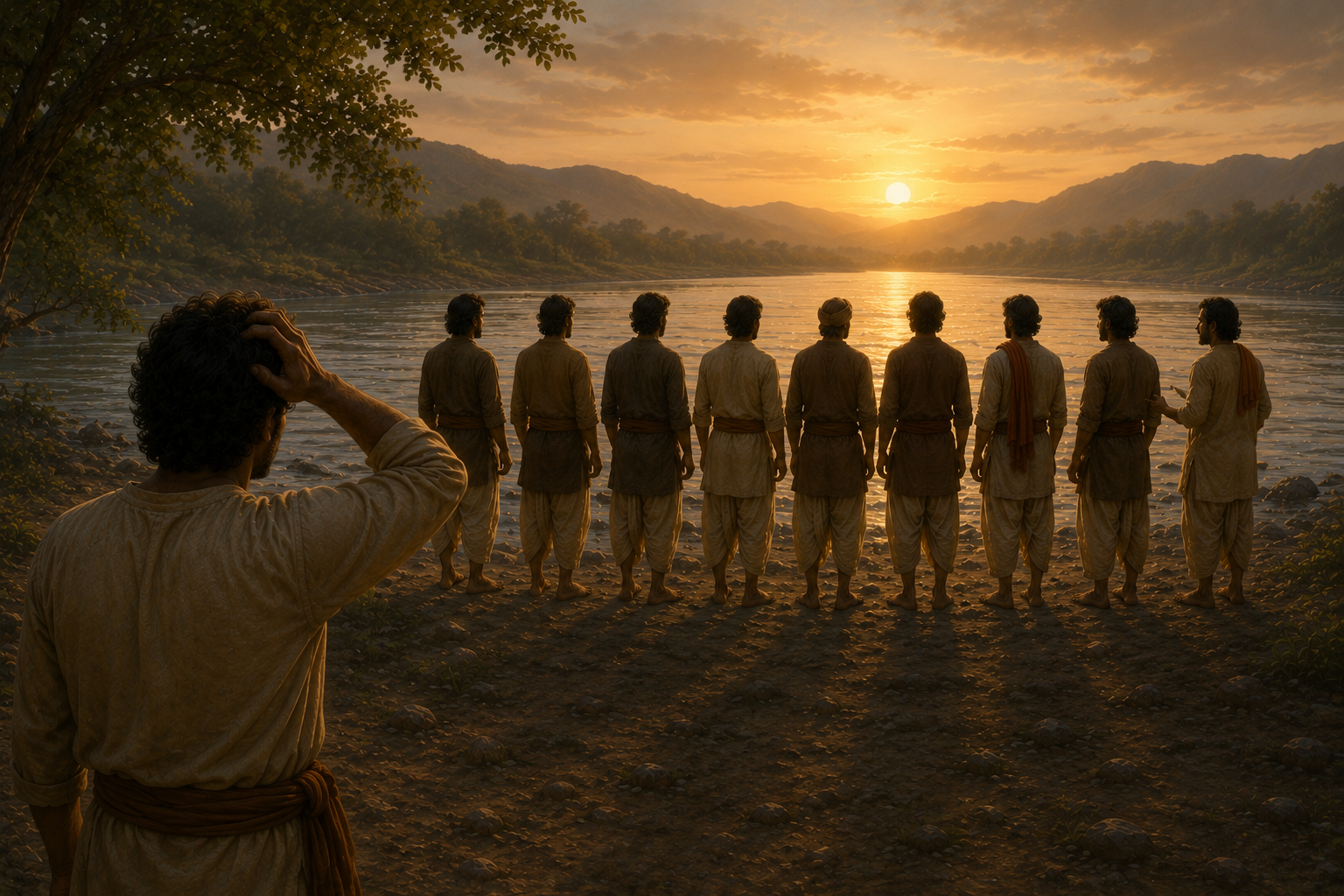
Ten students cross a river in flood. Once safely on the far bank, their leader counts to make sure everyone made it across, and arrives, again and again, at nine — he counts every head but his own. Alarm spreads; the group is now convinced one of their number has drowned, and they sit on the riverbank in genuine, considerable grief. Others attempt the count and arrive at the identical result, each of them omitting themselves from their own tally in turn. A passing stranger, or in some versions a wiser elder, hears their lament, asks what happened, and — grasping the error at once — has each student count off aloud while receiving a light tap on the shoulder, ensuring each is counted precisely once, including himself. The tenth number is finally reached. Nobody was ever missing.
The story is old enough and well-enough embedded in the tradition's oral life that Ramana Maharshi returns to it repeatedly across his recorded conversations, using it as a standing reference for exactly the point this essay has been building toward. And the detail worth sitting with is not the twist ending — anyone can guess the twist from the first sentence — but the fact that the grief was completely real while it lasted. The tenth student was never actually gone, not for one instant, and yet the group's mourning was not therefore fake, foolish in a way that could simply have been talked out of them by an outside voice insisting "nobody is missing, stop crying." That sentence, true as it is, would have changed nothing. What changed something was the recount — the whole procedure had to actually run, the students had to be walked through their own error at the pace and in the form the error itself was made, before the missing tenth man could stop being missing to them.
This is the entire justification, compressed into a single memorable image, for why Shankara built the apparatus he built rather than simply repeating Gaudapada's ajativada more loudly. Sadhana — the guru, the scriptural study, the meditation, the years of practice — is the recount. Nobody needs the recount to make the tenth man exist; he was never absent from the actual number. Everybody needs the recount to stop grieving him.
Part Seven: The Cost of Skipping the Method
If the technical truth alone were sufficient, the tradition would simply state it and move on, and would have no particular objection to a student who heard "you are already Brahman, there is nothing to attain" once, agreed fluently, and considered the matter closed. The tradition's own literature is unusually alert to exactly this failure mode, and unusually unkind to it. The Vivekachudamani, traditionally attributed to Shankara, spends real energy distinguishing the person who has merely mastered the vocabulary of non-duality — who can produce the correct sentences about Brahman on command — from the person who has actually recognised what those sentences describe. Verbal facility with "tat tvam asi" is treated, repeatedly and pointedly, as a specific and recognisable danger rather than a harmless approximation of the real thing: a mind that has memorised the description of water and now believes itself no longer thirsty.
This is why the goal-language persists in how living teachers actually speak, and persists deliberately rather than carelessly. A student handed the retraction before ever being led through the superimposition does not skip to enlightenment; they acquire a second, more sophisticated form of the original confusion, now reinforced by genuine-sounding vocabulary that makes it harder, not easier, to notice the confusion is still operating. The count still has to happen. Announcing the answer in advance does not exempt anyone from being walked through their own error at the pace an error actually requires to be seen clearly and released.
Conclusion: The Recount Is Not a Lesser Truth
None of this means the swamis are being loose with the doctrine when they speak of striving, of crossing over, of the long road to freedom. They are running adhyaropa, in public, for people who are not yet in a position to hear apavada — which is not a failure of rigor but the first, indispensable half of the only teaching method the tradition has ever found workable for a truth that cannot be stated without first being staged. Gaudapada's ajativada is the fact of the matter, available in full to anyone who has already done the recount. Shankara's entire architecture — the guru, the scripture, the stages, the goal-language itself — is the recount, built because the fact alone, however true, was never going to reach anyone still convinced a member of their own party was drowned.
It is worth being precise about what this does and does not license, because the same argument that defends goal-language against the charge of imprecision could, carelessly handled, defend almost any comforting simplification a teacher might prefer. The difference is that adhyaropa is disciplined by its ending. A teacher genuinely running the classical method knows, and eventually says, that the goal-language was scaffolding — the raft gets named as a raft, sooner or later, to anyone who stays with the teaching long enough to ask. What the method does not license is a permanent, undisclosed goal-language that never gets retracted at all, offered to students who are never told a retraction is coming. That is not adhyaropa; it is simply leaving the scaffolding up and calling it the building. The tradition's own literature is exactly as alert to this failure as it is to the opposite one of announcing apavada too soon. Both are named. Both are treated as genuine errors in transmission, not harmless variations in teaching style.
So when a living teacher tells a room full of students to strive for moksha, to break the cycle, to work toward freedom, the accurate description of what is happening is not that the teacher has quietly decided rigor is optional for beginners. It is that the teacher is doing, in real time, exactly what Shankara's own line prescribes — explaining what is free of multiplicity by way of superimposition, with the negation to follow whenever the student is actually able to hear it and not one moment before. The count has to happen at the pace of the person doing the counting. That is not a compromise the tradition made reluctantly. It is the only method anyone has ever found that gets a grieving man to stop grieving a friend who was never gone.
The tenth man was never missing. Everyone still has to be counted.