There is a story told about India and conquest — a story so deeply embedded in the popular imagination that it has acquired the status of obvious fact. India was conquered. Repeatedly. By the Mughals, by the British. It received these conquerors with a kind of civilisational resignation, absorbed them as it had absorbed everything else, and waited — until Gandhi arrived and showed the world how a nation could win its freedom without firing a shot.
This story is false in almost every particular.
India was never fully conquered. Not by the Arabs, not by the Turks, not by the Mughals, not by the British. Every conqueror who set foot on the subcontinent found that taking India was the easy part. Holding it was something else entirely — a generations-long, blood-soaked project that drained empires, exhausted armies, and was never, in the full sense of the word, completed. The subcontinent fought back. Continuously. Ferociously. With a strategic depth and civilisational resilience that no invading force ever fully overcame.
And when the British finally left in 1947, they did not leave because a lawyer in a dhoti had embarrassed them with a salt march. They left because a century of armed rebellion, mutiny, guerrilla warfare, assassination, and the terrifying prospect of a fully militarised Indian resistance had made the arithmetic of empire impossible. Gandhi gave them a face-saving exit. The soldiers, the rebels, the mutineers, and the martyrs had already made staying untenable.
This is the story that Indian history has not told clearly enough. It is time to tell it.
The Five-Century Gap
Muhammad bin Qasim conquered Sind in 711 CE. This is the conventional starting point of Islamic conquest in the Indian subcontinent — a moment that is presented, in most popular histories, as the beginning of a relatively straightforward process of subjugation that would culminate in the Mughal Empire's dominance over the entire subcontinent.
What this framing obscures is the five-hundred-year gap between the fall of Sind and the fall of Delhi.
Five hundred years. For five centuries after the Arab conquest of Sind, the Islamic advance into the Indian heartland was effectively halted. The armies that had swept from Arabia to Spain in a generation, that had dismantled the Sassanid Persian Empire in a decade, that had transformed the religious landscape of the entire Middle East within a human lifetime — these armies spent five hundred years trying to push past the Indus into the great plains of northern India, and failing.
They failed because India fought back. The Rajput confederacies of Rajasthan, Malwa, and the Gangetic plain constituted a military culture of extraordinary tenacity — cavalry armies of professional warriors organised around a code of martial honour that made retreat a worse fate than death. The Arab and early Ghaznavid raids that penetrated beyond Sind found themselves fighting not passive populations but organised, ferocious resistance from kingdoms that understood, with complete clarity, what was at stake.
Nagabhata II of the Gurjara-Pratihara dynasty defeated the Arab forces at the Battle of Rajasthan in the early eighth century — a victory that halted the westward advance and secured the Gangetic plain for generations. His successors maintained this defensive line for over a century. The Chandelas, the Paramaras, the Chahamanas — each of these Rajput dynasties contributed to a multi-generational resistance that the Islamic advance could not break.
"Five centuries after the Arab conquest of Sind, the Islamic advance into the Indian heartland was effectively halted. The armies that had dismantled the Persian Empire in a decade spent five hundred years trying to push past the Indus."
Mahmud of Ghazni conducted seventeen raids into the subcontinent between 1000 and 1027 CE — raids of extraordinary destructiveness that reached as far as Somnath and Mathura. But Mahmud, for all his military brilliance and all his destruction, never attempted to hold the territory he raided. He could not. The resistance he encountered made permanent occupation impossible with the forces he had available. He raided, he plundered, he destroyed — and he returned to Ghazni. The raids were symptoms of military superiority in the field. The withdrawal was an acknowledgment of something deeper: that India could not be held.
Prithviraj Chauhan and the Cost of Tarain
The First Battle of Tarain in 1191 CE is one of the most consequential military engagements in Indian history — and one of the most consistently underweighted. Prithviraj Chauhan, ruler of the Chahamana dynasty and the last great Hindu emperor of northern India, met the forces of Muhammad of Ghor at Tarain and defeated them decisively. Muhammad himself was wounded and nearly captured. His army was routed. The invasion was turned back.
The following year, Muhammad returned with a larger army, modified his tactics, and won the Second Battle of Tarain in 1192 CE — capturing and subsequently executing Prithviraj. This second battle is the one history remembers. The first battle — the one India won — is largely forgotten.
The forgetting matters. Because the first battle of Tarain demonstrates something important: the Islamic conquest of northern India was not inevitable. It was won by a margin. It required specific military adjustments, specific tactical innovations, and specific failures of Indian political unity to succeed. A united Rajput confederacy that had fought as effectively at the Second Battle as it did at the First might have turned the tide entirely.
What followed the Second Battle of Tarain was not smooth conquest but decades of fierce resistance. The Rajput kingdoms did not submit. They were reduced, one by one, through sustained military campaigns that cost the Delhi Sultanate enormously. Ranthambore fell in 1301 after a prolonged siege. Chittorgarh fell in 1303, also after a siege, and its Rajput defenders chose mass death over surrender. Jalor fell in 1311. Each of these was not a conquest but a battle — hard-fought, costly, and followed by continued resistance in the surrounding territories.
The Rajput military tradition did not die with the establishment of the Delhi Sultanate. It retreated, regrouped, and continued. Mewar under the Sisodia dynasty maintained continuous resistance across two centuries of Sultanate rule. Rana Sanga of Mewar was, at the beginning of the sixteenth century, arguably the most powerful ruler in northern India — the man who would have defeated Babur at Khanwa in 1527 if the battle had gone differently. The Rajputs were never fully subdued. They negotiated, they fought, they made tactical accommodations — and they preserved their autonomy and their identity through the entire period of Muslim rule in northern India.
The South That Was Never Conquered
The conventional narrative of Islamic conquest focuses on the north — the Delhi Sultanate, the Mughals, the great battles of the Gangetic plain. What it consistently underweights is the simple geographical fact that the Deccan and the far south of the subcontinent were never durably conquered at all.
The Deccan Sultanates — Bahmani and its successor states — controlled the northern Deccan from the mid-fourteenth century. But south of the Krishna and Tungabhadra rivers lay a different reality entirely. The Vijayanagara Empire, founded in 1336 CE by Harihara and Bukka Raya in the aftermath of the Khalji and Tughlaq raids into the south, constituted one of the most extraordinary acts of civilisational self-defence in Indian history.
Vijayanagara was founded explicitly as a bulwark. Its rulers understood that they were holding a line — that the temples of Tamil Nadu, Karnataka, and Andhra, the Shaiva and Vaishnava traditions of the south, the agrarian civilisation of the Deccan, depended on their military capacity to keep the forces of iconoclasm north of the Krishna. For over two hundred years, they succeeded. The Vijayanagara army — which at its peak was among the largest in the world — fought continuous wars against the Bahmani and successor Deccan Sultanates and consistently held or expanded its territory.
The Battle of Talikota in 1565 CE, in which a coalition of the Deccan Sultanates defeated and killed Aliya Rama Raya and subsequently sacked the city of Vijayanagara, is presented as the fall of the empire. But even after Talikota, the Vijayanagara royal lineage continued — fragmenting into successor states that maintained resistance across the Deccan and Tamil country for another century. The city fell. The resistance continued.
And south of the Kaveri, in the deep Tamil country, the great temple complexes — Madurai, Srirangam, Chidambaram, Tirupati — survived. They survived because Vijayanagara had held the line long enough for the momentum of conquest to exhaust itself. The south was not saved by passivity. It was saved by two centuries of continuous warfare conducted by an empire that understood its civilisational purpose.
Shivaji and the Maratha Counterattack
By the mid-seventeenth century, the Mughal Empire under Aurangzeb had achieved its greatest territorial extent. It controlled virtually the entire subcontinent from Kabul to the Cauvery. Its administrative apparatus, its revenue system, its military machine were the most sophisticated on the subcontinent. On paper, the conquest was complete.
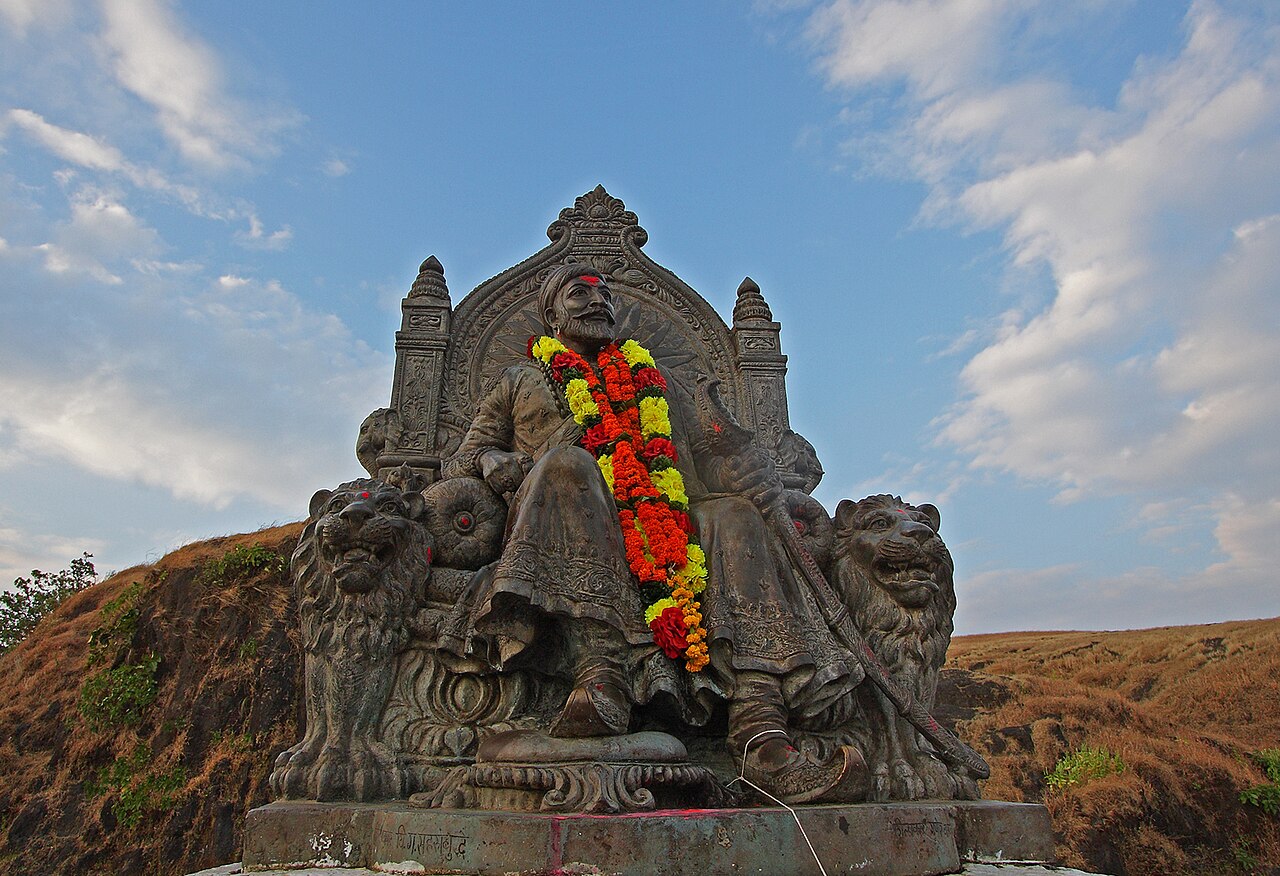
In 1659, a twenty-nine-year-old Maratha chieftain met the Bijapur general Afzal Khan at Pratapgarh and killed him with a concealed weapon — the wagh nakh, the tiger claws — in a meeting that was supposed to be a peaceful negotiation. Shivaji had understood, correctly, that the meeting was a trap. His response was not negotiation but preemptive violence. It was the opening move of one of the most remarkable military careers in Indian history.
Shivaji did not merely resist Mughal expansion. He built an alternative state — a Maratha Swarajya rooted in the Deccan countryside, financed by a systematic revenue administration, defended by a network of hill forts that turned the terrain of the Western Ghats into an unconquerable labyrinth, and sustained by a military philosophy that emphasised mobility, surprise, and the exploitation of the Mughal Empire's administrative overextension.
The Marathas fought the Mughals for decades under Shivaji and his successors — draining the empire's resources, tying down its armies, and demonstrating with increasing clarity that the Mughal administrative model could not function in the face of determined guerrilla resistance from a militarised agrarian population with intimate knowledge of the terrain.
After Shivaji's death and the subsequent Mughal pressure under Aurangzeb, the Maratha Confederacy under the Peshwas took the fight northward with a ferocity that the Mughals had never anticipated. Maratha cavalry raided Delhi in 1737. By 1758, Maratha forces had reached Attock on the Indus — the westernmost point any Hindu army had reached since the ancient period. The empire that Aurangzeb had spent his entire reign attempting to consolidate was being dismantled from within by the people he had spent that same reign attempting to subjugate.
"In 1758, Maratha forces reached Attock on the Indus. The empire Aurangzeb had spent his reign trying to consolidate was being dismantled by the people he had spent that reign trying to subjugate."
Panipat in 1761 halted the Maratha advance. But even after that catastrophic defeat, the Marathas regrouped, rebuilt, and continued as the dominant power in the subcontinent until the British wars of the early nineteenth century. The Mughal Empire, by contrast, never recovered. It limped forward as a British client state until 1857, when the last Mughal emperor was deposed and exiled to Rangoon. The conquerors had been conquered in turn.
Ranjit Singh and the Lion's Share
The Sikh Empire under Maharaja Ranjit Singh represents perhaps the clearest example in Indian history of indigenous military power not merely resisting foreign conquest but building a state capable of projecting force on terms of genuine equality with the most powerful military organisations of the age.
Ranjit Singh, who came to power in Lahore in 1801, built his army on European lines — with French and Italian officers training Punjabi soldiers in the latest military techniques, with artillery of a quality that matched the best European armies of the period, with a discipline and organisation that impressed every foreign observer who encountered it. The Sikh Khalsa army that he built was, by the 1830s, arguably the finest army in Asia.
The British knew this. Their treatment of the Sikh Empire — cautious, respectful, marked by formal treaties that acknowledged Sikh sovereignty — was qualitatively different from their treatment of the Maratha Confederacy, the Nizam of Hyderabad, or the kingdom of Mysore. They did not attempt to absorb the Sikh Empire through the doctrine of lapse, or through subsidiary alliances, or through the other mechanisms of absorption they applied to weaker states. They waited. They watched. And they did not move until after Ranjit Singh's death in 1839 had left the empire in the hands of successors who could not maintain its internal cohesion.
The two Anglo-Sikh Wars of 1845-46 and 1848-49 were the hardest fighting the British army experienced anywhere in the world during the Victorian period. The Sikhs fought with a ferocity and tactical sophistication that repeatedly shocked British commanders who had expected an easy campaign. Sir Hugh Gough, the British commander, described the Battle of Ferozeshah as the nearest run thing he had ever been involved in. The Punjab was annexed only after the internal collapse of Sikh political unity — not because British arms had demonstrated clear superiority in the field.
1857 and the War the British Never Forgot
The British called it the Sepoy Mutiny. Indian nationalists called it the First War of Independence. Neither name quite captures what actually happened in 1857 — the most serious military challenge the British Empire faced anywhere in the world between the Napoleonic Wars and the First World War.
The rising of 1857 was not a mutiny. It was a war. It involved not just sepoys but civilian populations, dispossessed princes, peasant communities who had been systematically impoverished by British land tenure policies, religious communities who saw in British rule an existential threat to their traditions. At its height, the British presence in large parts of northern India was reduced to isolated garrisons fighting for survival against a population that had decided, collectively and violently, that enough was enough.
The siege of Lucknow lasted from May to November 1857 — nearly six months during which the British garrison held out against a besieging force while relief columns fought their way through hostile territory. The relief of Lucknow is commemorated in British military history as an act of heroism. What it actually demonstrates is the scale of the challenge the British faced — a challenge so serious that it required the commitment of virtually the entire available military force of the empire to suppress.
Lakshmi Bai, the Rani of Jhansi, who died fighting the British at Gwalior in June 1858, was described by the British commander Hugh Rose as "the most dangerous of all the Indian leaders." She was twenty-two years old. She had taken up arms after the British annexed her kingdom under the doctrine of lapse following her husband's death. She fought, on horseback, at the head of her troops, until she was killed in battle. She is not a symbol of non-violent resistance. She is a symbol of what Indian resistance to British rule actually looked like.
The British suppressed the 1857 rising with overwhelming force and extraordinary brutality. They blew sepoys from cannon. They burned villages. They executed captured fighters in numbers that India had not seen since the Mughal campaigns. They suppressed it — and they never forgot it. From 1857 onward, the fundamental concern of British Indian policy was not economic extraction or administrative efficiency. It was the prevention of another 1857. The entire architecture of the Raj — the balance of communities, the careful management of the army's ethnic composition, the political accommodations and the intelligence apparatus — was built around one question: how do we prevent this happening again?
The Violent Century the History Books Minimise
The standard narrative of Indian independence presents the period between 1857 and 1947 as largely the story of the Congress movement — petitions, negotiations, constitutional reforms, the gradual transfer of power from British to Indian hands, culminating in Gandhi's non-violent campaigns and the eventual British decision to leave.
This narrative is not false. It is incomplete in a way that amounts to falsification.
The British faced continuous armed resistance throughout this period. Bal Gangadhar Tilak, who understood that the British responded to force more reliably than to petition, built a mass movement around the proposition that swaraj was a birthright that had to be seized, not a concession that could be requested. Vinayak Damodar Savarkar, imprisoned in the Andaman cellular jail for a decade and a half for revolutionary activities, represents a tradition of violent anti-colonial resistance that Indian official history has been systematically reluctant to celebrate.
Bhagat Singh, Rajguru, and Sukhdev were hanged by the British in March 1931 for the assassination of a police officer who had ordered a lathi charge that killed Lala Lajpat Rai. They were twenty-three, twenty-two, and twenty-four years old respectively. They went to the gallows singing. The British executed them because they were afraid of them — afraid of what they represented, afraid of the movement they were building, afraid that a generation of young Indians was concluding that the only language the empire understood was violence.
Subhas Chandra Bose's Indian National Army — which recruited from Indian prisoners of war taken by the Japanese and from the Indian diaspora of Southeast Asia, which fought British forces in the Arakan and at Imphal-Kohima, which raised the Indian tricolour over Moirang in Manipur — represented something the British found more threatening than anything Gandhi ever did. The INA trials of 1945-46, in which three INA officers were prosecuted for treason, triggered mass demonstrations, naval mutinies, and a wave of civil unrest that convinced the British military and political leadership that the loyalty of the Indian armed forces could no longer be guaranteed.
It was the naval mutiny of February 1946 — in which Indian ratings seized warships in Bombay harbour and raised the flags of Congress, the Muslim League, and the Communist Party side by side — that finally convinced the British that the game was up. Not the salt march. Not the Quit India movement, which the British had suppressed with considerable efficiency in 1942. The mutiny — the moment when the armed forces of the empire itself declared that they would no longer serve.
Gandhi and the Exit That Was Already Arranged
None of this is to dismiss Gandhi's personal courage, his moral vision, or his genuine influence on the independence movement. He was a figure of extraordinary individual integrity who genuinely believed in the philosophy he preached and paid personal costs for it. He belongs in the story of Indian independence.
But the story of Indian independence is not his story alone. And the presentation of Indian independence as primarily the achievement of non-violent resistance — with Gandhi as the protagonist and the British as the moral audience who eventually responded to the force of his example — is a narrative that serves British interests more than Indian ones.
It serves British interests because it frames the end of empire as a moral choice freely made by a civilised nation responding to the moral suasion of a saintly opponent — rather than as a strategic retreat forced by a century of armed resistance, two World Wars that had bankrupted Britain and destroyed its capacity for sustained imperial violence, and a military establishment that had concluded that holding India would require more than the British public was willing to pay.
Clement Attlee, the British Prime Minister who presided over the transfer of power, was asked years later what had been the primary cause of British withdrawal from India. His answer was not Gandhi. It was Bose — the threat that the Indian armed forces would no longer be reliable instruments of British power.
Gandhi was, from the British perspective, a gift. Not a threat but a solution. A leader who could channel Indian anger into forms the British could manage — marches, fasts, civil disobedience — rather than the armed rebellion that the British genuinely feared. When Gandhi called off the Non-Cooperation Movement in 1922 after the Chauri Chaura incident, in which a mob burned a police station killing twenty-two policemen, he removed from the table the one form of pressure the British actually feared. They rewarded him with negotiation. They were less generous to Bhagat Singh.
This is not conspiracy theory. It is the observable pattern of British response across the entire independence period. The British negotiated with the non-violent. They executed, imprisoned, and exiled the violent. They feared the violent. They managed the non-violent. The differential treatment reveals the differential threat.
The Undefeated Subcontinent
India was never fully conquered. This is the fact that the conventional narrative of conquest and passivity obscures — and it is a fact worth insisting on with some force, because it changes everything about how the subcontinent's history is understood.
Sind fell in 711 CE. Delhi fell in 1192 CE. The south was never durably conquered. The Marathas counterattacked and reached the Indus. The Sikhs built a state the British approached with genuine respect. 1857 nearly ended the Raj before it had properly begun. A century of continuous armed resistance — from Tilak to Savarkar to Bhagat Singh to Bose to the naval mutineers — made the arithmetic of empire impossible.
This is not a story of inevitable conquest and patient endurance. It is a story of continuous resistance — sometimes losing, sometimes winning, always fighting — by a civilisation that understood, across a thousand years and through every form of pressure that history could devise, that what was being contested was worth fighting for.
The temples that stand today in Tamil Nadu, in Karnataka, in Rajasthan, in the Deccan — they stand because people fought for them. Not metaphorically. With swords, with cavalry, with guerrilla tactics in the Western Ghats, with mutiny in the barracks of Meerut, with bombs in the colonial legislature, with the willingness to climb the gallows at twenty-three years old singing songs of revolution.
India is a land that has never stopped fighting for itself. The passive, spiritual, non-violent India of Western imagination — of a certain strand of Indian self-presentation — is a myth that does injustice to every soldier, every rebel, every mutineer, every revolutionary who paid in blood for the country that exists today.
They deserve to be remembered accurately. Not as the background to Gandhi's story. As the protagonists of their own.
