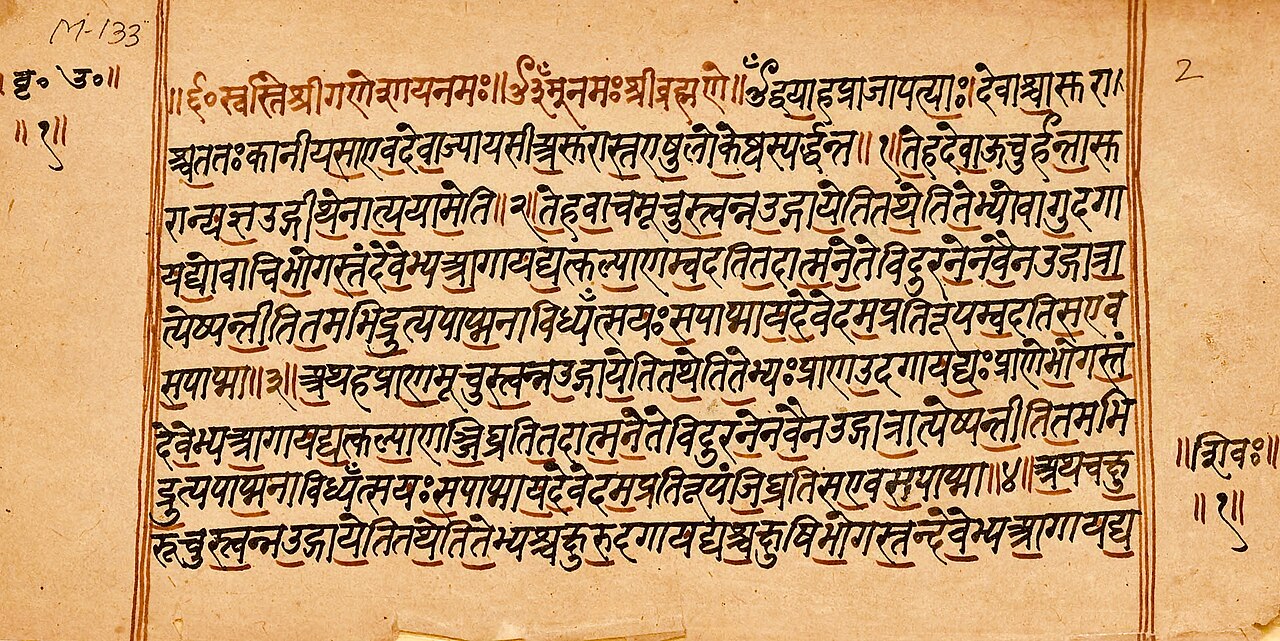
I. The Mandukya Upanishad — The Most Direct Statement
The Mandukya Upanishad is the shortest of the principal Upanishads — twelve verses — and arguably the most philosophically concentrated. It opens without preamble:
The universality is absolute from the first verse. Everything — past, present, future, and what lies beyond time itself — is Om, which is Brahman. Not: everything participates in Brahman. Not: everything is sustained by Brahman. Everything is Brahman.
The second verse follows immediately:
Two declarations in a single verse: all of this is Brahman, and the Atman is Brahman. The Mandukya then proceeds to its famous analysis of the four states of consciousness — waking (jagrat), dreaming (svapna), deep sleep (sushupti), and the fourth (turiya) — arriving at the recognition that turiya is not a fourth state alongside the others but the ground of all three. It is pure, non-dual awareness — identified explicitly with Brahman.
No other reading of this Upanishad is textually sustainable. The declarations of identity are not metaphorical. They are the primary teaching.
II. The Chandogya Upanishad — The Teaching of Tat Tvam Asi
The Chandogya Upanishad contains the most famous of the Mahavakyas — Tat Tvam Asi — "That thou art." It appears not once but nine times in the sixth chapter, as the sage Uddalaka Aruni repeats it to his son Svetaketu after each of a series of analogies. On salt dissolved in water:
The analogy is precise: when salt is dissolved in water, it cannot be seen, but it pervades every drop. Yet the salt is not merely related to or participating in the water. It is the water, in every part. Similarly, Brahman pervades all of existence not as a separate sustaining principle but as the very reality of everything that appears.
Not "thou art like That." Not "thou art a part of That." Thou art That.
The Chandogya also contains the famous passage on rivers and the sea: "As rivers flowing east and west merge in the sea and become one with it, forgetting they were ever separate rivers, so all creatures lose their separateness when they merge at last into pure Being." This is not the language of eternal distinction. This is the language of identity — the complete dissolution of the sense of separateness in the recognition of what was always true.
Madhva's reading — that Tat Tvam Asi means the soul enters Brahman as a drop enters the ocean, remaining distinct within it — founders on the Chandogya's own analogy. The text says the rivers forget they were ever separate. Forgetfulness of separateness is not the maintenance of separateness in a new form. It is the recognition that the separateness was never real.
III. The Brihadaranyaka Upanishad — Yajnavalkya's Non-Dual Vision
The Brihadaranyaka Upanishad is perhaps the most philosophically dense of all the Upanishads. Its central figure, the sage Yajnavalkya, is the supreme Upanishadic teacher of non-dualism. The Mahavakya from this Upanishad:
This is not a statement of devotion or aspiration. It is a statement of recognition — the recognition of what is already and always the case. Aham Brahmāsmi is not "I wish to become Brahman" or "I am a part of Brahman." It is "I am Brahman" — present tense, first person, unconditional.
Yajnavalkya's teaching also gives us the via negativa of the Upanishads:
This is the systematic negation of every attribute, every quality, every description as inadequate to Brahman. Ramanuja's saguna Brahman — possessing infinite auspicious qualities — requires reading the neti neti passage as a statement about the inadequacy of finite attributes only. This reading strains the text considerably. The neti neti of the Brihadaranyaka is not a partial negation. It is a total negation — "not this, not this" — leaving nothing that can be predicated of Brahman as an attribute in the way qualities are predicated of finite things.
IV. The Mundaka Upanishad — The Two Birds and the Higher Knowledge
The Mundaka Upanishad opens with the famous distinction between para vidya (higher knowledge) and apara vidya (lower knowledge). Higher knowledge is that by which the imperishable Brahman is directly known.
The knower of Brahman does not come near Brahman. Does not participate in Brahman. Does not dwell eternally in Brahman's presence. The knower of Brahman becomes Brahman. The Mundaka also contains the famous two-birds allegory:
The Advaitic reading: the two birds are ultimately one — the appearance of duality between the individual soul and the Supreme Self is the fundamental ignorance. When the individual soul recognises the witness — the pure awareness that never acts, never suffers, never changes — it recognises that this witness is what it always was. The jiva was always the Paramatman. The appearance of duality dissolves in the recognition of what was always one.
V. The Katha Upanishad — Death's Teaching on the Self
The Katha Upanishad is structured as a conversation between the young Nachiketa and Yama, the god of death, on the nature of the self and liberation. Yama teaches:
The Atman here is not described as a separate soul related to a separate God. It is described as the ultimate reality — subtler than the smallest, greater than the greatest — dwelling at the core of every creature. This is the Advaitic Atman: not a limited individual soul but the infinite Brahman appearing as the witness of individual experience.
VI. The Isha Upanishad — The Fullness That Remains
The Isha Upanishad's peace invocation is a perfect expression of Advaitic non-dualism:
Brahman is the infinite fullness. The world arises from that fullness. Yet even after the world arises, the fullness remains undiminished — because the world is not something separate from Brahman that reduces it. The world is Brahman appearing as the world. Remove the appearance and the fullness remains, because only the fullness ever existed. This is not the language of a personal God creating a separate world. It is the language of a non-dual Absolute from which nothing truly separate ever emerged.
VII. The Taittiriya Upanishad — Brahman as Bliss
The Taittiriya Upanishad contains one of the most direct definitions of Brahman:
Not a person. Not a being with qualities in the ordinary sense. Truth (satyam), Knowledge (jñānam), Infinite (anantam) — three terms that describe not attributes possessed by a subject but the very nature of what Brahman is. The same Upanishad then describes the pancha kosha — the five sheaths — as coverings of the Atman, each subtler than the last, culminating in the recognition that the Atman at the core is pure bliss (ananda) — identical with the Brahman described as sat-chit-ananda in the non-dual recognition.
VIII. What the Upanishads Do Not Say
Having examined what the Upanishads say, it is worth briefly noting what they do not say — because the silences are as philosophically significant as the declarations.
The Upanishads do not say: "The individual soul and Brahman are similar but distinct." They do not say: "The soul participates in Brahman while retaining its individuality." They do not say: "Brahman is the soul of souls and the souls are its body." These are interpretations — sophisticated, devotionally meaningful interpretations — but they are not what the texts say in their own voice.
What the Upanishads say, repeatedly, directly, and without qualification, is: Aham Brahmāsmi. Tat Tvam Asi. Ayam Ātmā Brahma. Prajñānam Brahma. The self is Brahman. Thou art That. This Atman is Brahman. Consciousness is Brahman.
Advaita requires only that we listen to what the Upanishads are actually saying — and have the philosophical courage to follow that saying to its ultimate conclusion.
Advaita takes these statements at face value. It does not require the grammatical gymnastics of Madhva's atat tvam asi, which transforms "thou art That" into "thou art not That." It does not require the qualification of Ramanuja's interpretation, which reads the identity statements as statements of a body-soul relationship rather than strict non-difference. Advaita requires only that we listen to what the Upanishads are actually saying — and have the philosophical courage to follow that saying to its ultimate conclusion.
Conclusion: The Most Faithful Reading
The Upanishads are not a uniform, systematic philosophical treatise. They are a collection of conversations, meditations, inquiries, and revelations spanning centuries and multiple traditions. They contain passages that, read in isolation, can be made to support qualified non-dualism or even dualism. The tradition of Vedantic commentary exists precisely because these texts require interpretation.
But when the Upanishads are read as a whole — when the dominant voice is heard rather than the marginal ones, when the Mahavakyas are taken as the summit of the teaching rather than subordinated to other passages, when the analogies (salt in water, rivers in the sea, the full that remains after the full is taken) are allowed to mean what they most naturally mean — the conclusion is the one Advaita has always defended.
Brahman alone is real. The world is mithya — not unreal in the sense of non-existent, but relatively real, real within its own order, not independently real. The individual soul is none other than Brahman, appearing as individual due to the superimposition of avidya. Liberation is the recognition of this — not an event in time, not a journey toward something external, but the falling away of a misidentification that was never true.
This is what the Upanishads teach. This is what Advaita has always said. The alignment is not a coincidence. It is fidelity.
