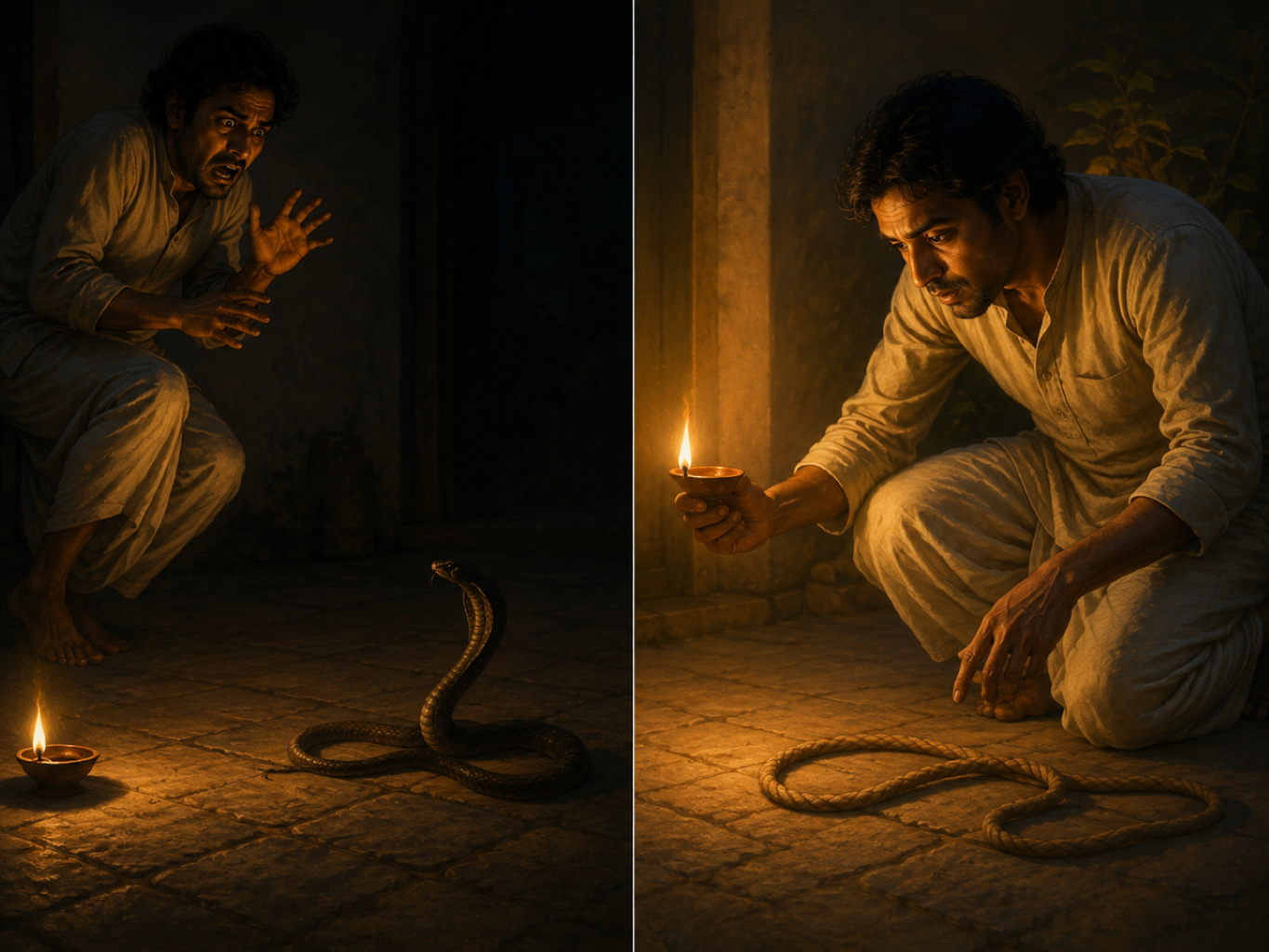
Glowing oil lamps in the dark
Photo by AJAY KUMAR on Pexels
Manovanam  ›  The Philosopher's Grove  ›  Essay

Advaita Vedanta, Mapped

The whole arc, from the one reality to what actually changes when it's realized — in a single picture

Advaita Vedanta is usually taught the way it was written — commentary upon commentary, one technical term unlocking the next. That's the right way to actually study it. It is not the right way to first see the shape of the whole thing.

So here is the whole thing, in one flowchart: what Brahman is, why the world appears at all, what that produces in an ordinary human life, what the teaching actually claims, and what changes — not fixed, but seen through — once it lands.

One piece worth flagging before you look at it: Brahman itself splits into two readings right at the top, and everything downstream depends on that split. Nirguna Brahman is the formless absolute — it never touches the world, never projects anything, never does. Saguna Brahman, or Ishvara, is the personal God, Brahman considered together with Maya — and it's only at this level that any projecting, any "why does the one appear as many," happens at all. Skip this distinction and the whole rest of the chart looks like Brahman itself is doing something. It isn't. Only Ishvara is.

Flowchart of Advaita Vedanta, from Brahman through Maya, Avidya, and the human predicament, to the teaching Tat Tvam Asi, the path of karma, upasana and jnana, and Moksha
The core arc of Advaita Vedanta, Brahman to Moksha

One line worth sitting with, since it's easy to read past: nothing in the green box is a fix. Duhkha doesn't get solved the way a problem gets solved. It turns out there was never a separate sufferer to begin with. That's the actual claim, and it's a stranger and more demanding one than most summaries let on.

Preview of the detailed Advaita Vedanta flowchart

Want the fuller picture?

A denser version of this same map, with the scholastic layer included — the Bhamati/Vivarana debate over where avidya actually sits, the five sheaths, the three states and Turiya, the four Mahavakyas, and the full Human Predicament → Resolution table.

Open the full PDF  →
MR

Muthukumar Rajagopalan

Writes on Indian philosophy, Jyotisha, military history, and geopolitics at Manovanam.