There is a quiet, persistent idea that treats ritual itself — all of it, the Vedic fire no less than the village shrine — as the part of Hinduism a spiritually serious person eventually grows out of. On this view, the real tradition, the sophisticated tradition, the one that actually holds up under scrutiny, is the philosophy: the Upanishads, Advaita, the long contemplative journey toward jnana. Ritual is what you did before you understood. Once you understand, the story goes, you graduate — toward the ashram, toward meditation, toward a purified, rational, essentially private religion of contemplation, and the fire, the murti, the festival, the terracotta horse at the village boundary quietly become things your grandmother did.
This essay argues the opposite, plainly and without qualification. It is ritual — Agni's flame, a consecrated Puranic murti, Ayyanar's clay horse standing sentinel at a village's edge — that has actually kept the Hindu heart beating, generation after generation, for thousands of years. The philosophical journey is real, and this whole body of essays has taken it with complete seriousness. But it was never the tradition's main artery. It was always a rare tributary, and mistaking the tributary for the artery is not spiritual sophistication. It is a way of quietly starving the thing that was actually doing the work.
Part One: The Real Divide
It is worth being precise about what this essay is defending and what it is not attacking, because the wrong opposing pair is easy to reach for here. This is not an essay setting Brahminical ritual against village ritual, Sanskritic tradition against folk tradition, one form of embodied worship against another. Vedic yajna, Puranic temple worship, and a village guardian's terracotta horse belong on the same side of the actual line this essay is drawing. They are siblings, not rivals, and nothing in what follows should be read as ranking one above the others.
The real divide runs somewhere else entirely: between ritual as such, in every one of its registers, and the impulse to treat ritual as a primitive stage that philosophical maturity eventually leaves behind. That impulse has a real history, and it is worth naming plainly rather than treating as an abstraction. The nineteenth-century reform movements are the clearest case. Ram Mohan Roy's Brahmo Samaj, drawing explicitly on both Vedantic monism and the Unitarian Christianity Roy had encountered directly, built an entire religious program around stripping away murti worship, temple ritual, and the elaborate ceremonial calendar in favor of a formless, ethical, hymn-singing monotheism, legible and respectable to a colonial, Protestant-inflected idea of what "true religion" ought to look like. Dayananda Saraswati's Arya Samaj pursued a parallel project from a different angle, rejecting Puranic worship and idol veneration in the name of a purified, Vedic-only religion stripped of what its founders considered later ritual accretion. Both movements were explicitly, proudly philosophical in self-conception, and both treated ritual — not merely folk ritual, all of it, Vedic included where it involved image or fire-offering rather than pure ethical monotheism — as exactly the primitive stage this essay is contesting.
The same impulse survives today in a more diffuse, less institutional form, and it is worth naming this version too, since it is the one most likely to actually be encountered by an educated Hindu today. It shows up as a quiet, unstated hierarchy in which meditation retreats, a well-thumbed Gita, fluency in Advaitic vocabulary, and time spent in or around an ashram read as the serious, adult practice of the religion, while a mother's daily puja, a temple priest's entire ritual vocation, or a family's yearly festival observance read as something more like inherited habit — sincere, perhaps sweet, but not where the real spiritual weight of the tradition is understood to live. Nobody necessarily states this hierarchy out loud. It rarely needs to be stated, because it is carried in which practices get called "spiritual" in casual conversation and which get called merely "cultural" or "traditional."
Part Two: What Actually Unites Agni, Murti, and Ayyanar
Look at the three ends of the ritual spectrum this essay is defending together, and the kinship between them is much closer than the reform impulse ever wants to admit.
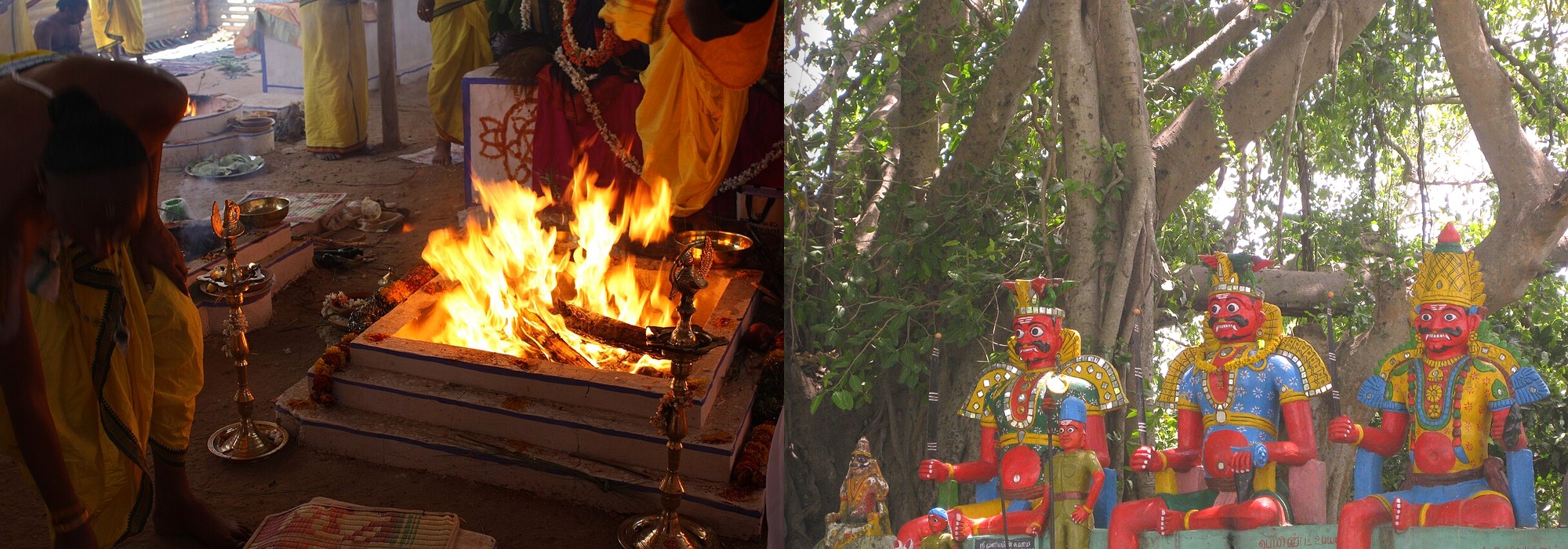
The Vedic fire — agnihotra, the larger srauta yajnas built around it — is exacting, technical, textually precise: exact Sanskrit formulae, ritual timing bound to sun and season, a priesthood trained for years to execute it correctly, because Vedic ritual theory holds that an error in performance can void or invert the result. Purva Mimamsa built a formidable technical apparatus around this precision, apurva, the unseen potency correctly performed ritual generates, ripening later into its promised fruit.
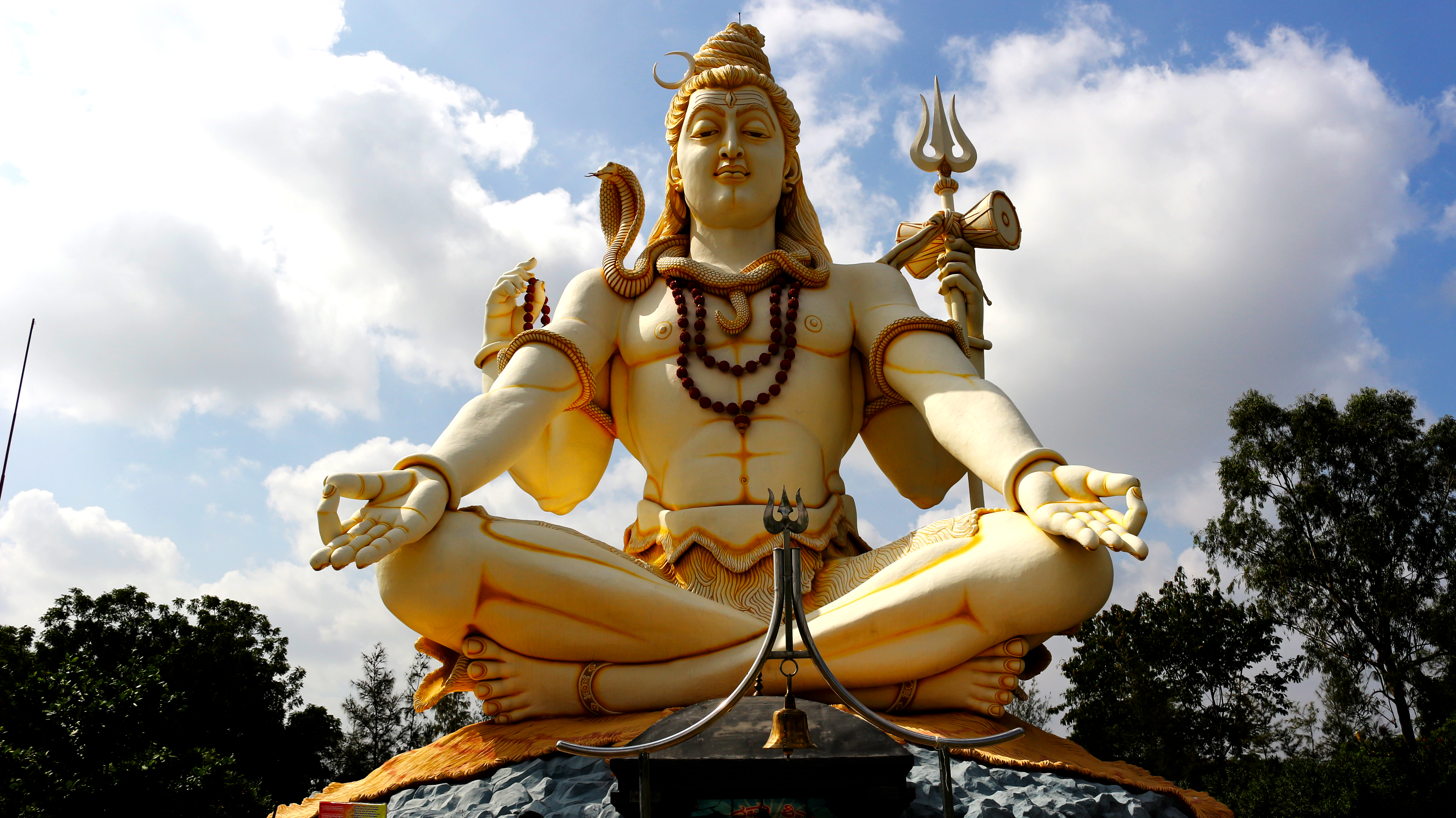
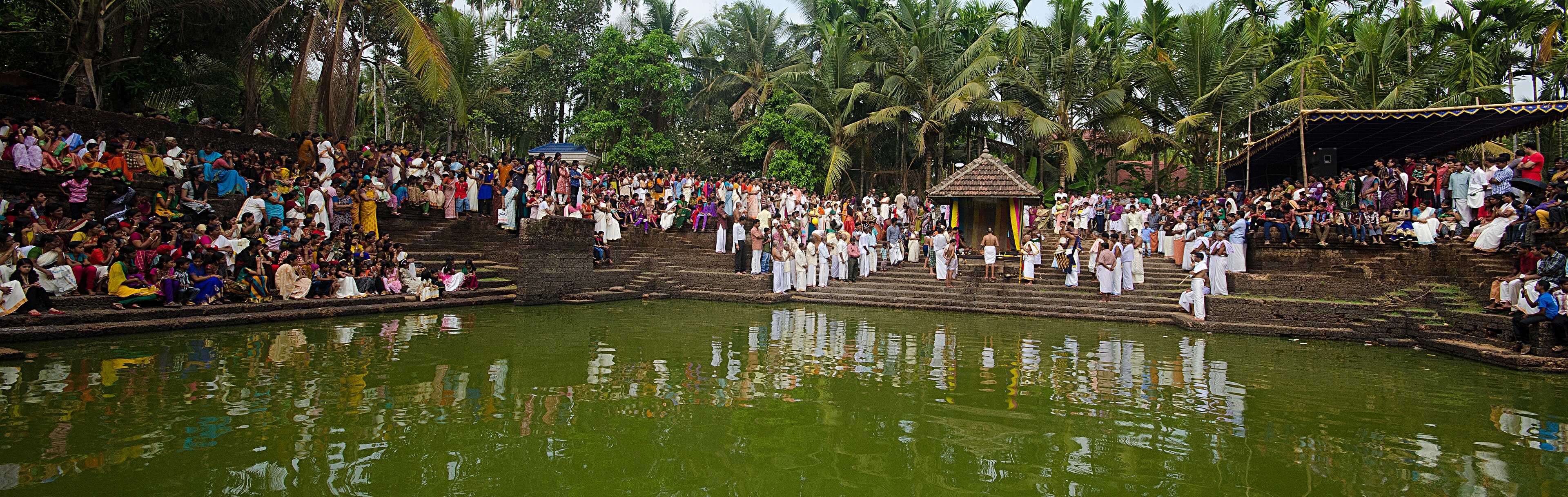
Puranic temple worship — murtis installed by agamic rule, the great pan-Indian deities in their iconic forms, the annual festival calendar recognized across the subcontinent — sits at what most people actually picture when they picture Hindu religion at all. It is itself, historically, substantially built from absorbed regional material: local deities, place-based sacred geography, and village myth-cycles folded into Sanskritic frame over centuries, given genealogies connecting them to Vishnu or Shiva. The "great" tradition did not descend intact from the Vedas. A great deal of it is village religion, one or two absorption-cycles further along — which is itself a sign of how porous and continuous the whole ritual spectrum actually is, not a mark against any part of it.
And Ayyanar — the guardian deity found at the boundary of virtually every Tamil village — completes the span. His shrines sit deliberately at the threshold between settlement and wilderness, exactly where his mythology assigns him to stand watch. Devotees commission enormous terracotta horses, crafted by the Velars, the potter-caste priests who serve him, consecrated in a ritual called Kutirai Etuppu, sometimes accompanied by trance and, in some regions, animal sacrifice. The horses stand through monsoon and sun until they crumble back into the earth they were shaped from, replaced each festival season by newly fired ones — an actual, literal cycle of dust to dust built directly into the practice rather than imposed on it afterward. Ayyanar's own history shows exactly the same porousness as the Puranic middle does: hero-stones from the third century CE attest to his worship centuries before any Sanskritic source mentions him, and later Puranic literature absorbed him as Hariharaputra, son of Hari and Hara, eventually identified with Ayyappan of Sabarimala, whose temple flagstaff still carries Ayyanar's horse as an iconographic trace of exactly where that lineage runs. The same living exchange connects a village shrine to one of South India's most visited pilgrimage sites.
None of this exchange between registers is the concern of this essay. Vedic, Puranic, and village ritual have always traded material back and forth, and that porousness is a genuine strength of a tradition without central doctrinal authority forcing uniformity. Nor is Ayyanar an isolated case chosen to make a narrow point. The same living, embodied ritual layer runs the length of the subcontinent: Mariamman and her regional counterparts, goddesses of disease, rain, and protection worshipped with their own ritual calendars and non-Brahmin priesthoods across Tamil Nadu and Andhra Pradesh; the countless grama devatas guarding a specific well, tree, or boundary stone in villages everywhere, each with a real name and a real local story; naga worship at snake-stones beneath sacred trees, propitiated for fertility across nearly every Indian region; and the veneration of specific pipal and banyan trees as living, inhabited presences, a practice old enough that its roots reach back to the Indus Valley period, well before the textual Vedic tradition existed in anything like its later form. The household's own Panchayatana worship of Shiva, Vishnu, Devi, Ganesha, and Surya together, often alongside whichever local or family deity a particular lineage has always kept, sits comfortably in the same company — one home, several registers of the identical ritual life, none of them felt as competing with the others.
What this essay is actually contesting is a wholly different move: not ritual absorbing ritual, but ritual — any of it, at any register, Vedic, Puranic, or village — being set aside entirely in favor of an abstracted, contemplation-only religion that treats none of this embodied practice as necessary anymore.
Part Three: Shankara's Own Witness
There is no better authority to call against the philosophizing impulse than the very philosopher whose name gets invoked to justify it. Adi Shankara proved, with real technical rigor, that jnana alone destroys ignorance — that no ritual action, however precisely performed, is the direct cause of liberation. It would be easy to conclude from this that Shankara himself favored philosophy over ritual, contemplation over ceremony, the ashram over the temple.
The historical record says the opposite, and says it loudly. This is the same man credited with organizing the Dashanami monastic order and founding mathas across the subcontinent — at Sringeri, Dwaraka, Puri, and Jyotirmath, each entrusted to one of his own direct disciples and assigned stewardship of one Veda — institutions built not to replace ritual with philosophy but to guarantee ritual's continued transmission for centuries after his own death. Shankara treated nitya karma, ordinary ritual obligation, as genuinely binding — not optional, not a lesser stage graciously tolerated for those not yet ready for something better — for virtually everyone, with the sole exemption, vidvat-sannyasa, reserved for a vanishingly rare person who has already achieved actual realization, not merely philosophical conviction. The gate that lets someone set ritual aside in favor of contemplation alone is, on Shankara's own account, almost never actually open. Everyone else remains bound to exactly the ritual life this essay is defending, and Shankara built permanent institutions to make sure that remained true. He is further credited with a substantial devotional and liturgical corpus of his own — hymns to Devi, Shiva, and Vishnu — output that would be a strange use of a philosopher's remaining time and energy if ritual and devotion were understood, even by their own most rigorous critic, as a stage meant to be finished with rather than sustained indefinitely.
If the greatest philosopher the tradition produced did not treat ritual as a stage to be outgrown, and in fact spent real institutional energy insuring against exactly that outcome, then the modern impulse to treat philosophy as ritual's replacement is not a return to Shankara's own teaching. It is a departure from it, dressed in his vocabulary.
Part Four: What Ritual Actually Does That Philosophy Cannot
Set the historical case aside for a moment and look at what actually happens, generation after generation, at the level of a single family or a single village. The tradition does not, in overwhelming practice, transmit itself through formal philosophical instruction. It transmits itself through a grandmother teaching a grandchild the specific gestures of arati, through the taste of a particular festival's prasadam, through the story behind why this village's boundary is guarded by this particular fierce rider on this particular horse, through the felt, embodied rhythm of a family's yearly rites. This is not a lesser, pre-philosophical mode of transmission awaiting eventual replacement by proper doctrinal instruction. It is the actual mechanism by which Hinduism has reproduced itself across roughly three and a half millennia, largely without a centralized clergy or a single canonical text enforcing uniformity, in a way that pure philosophical transmission — dependent on rare teachers, rare students, and a rare kind of leisure and inclination — never could have managed at civilizational scale.
This connects directly to the citta-shuddhi argument this whole body of essays has already built out at length: ritual purifies and steadies the mind, preparing it for a jnana that ritual itself cannot deliver. What is worth adding here is what that preparatory work actually looks like when multiplied across an entire civilization rather than a single aspirant's biography. Most people who perform agnihotra, attend temple festivals, or offer a terracotta horse to Ayyanar will never personally complete the philosophical journey to jnana in this lifetime, and the tradition's own architecture, plainly visible in how narrow Shankara made the exemption from ritual, assumes this will be true of nearly everyone. That is not a design flaw, and it is not evidence that these people's religious lives are somehow incomplete or preliminary. Ritual is not merely a waiting room outside the real event. It is the actual, sustained, civilizational-scale practice that has kept the tradition's heart beating continuously, century after century, entirely independent of how many individuals within it ever go on to complete the rarer philosophical path.
The samskaras make this concrete in a way worth spelling out directly, because they show ritual is not confined to temple and festival but structures an entire human life from before birth to after death. Jatakarma welcomes a newborn. Annaprashana marks the first taste of solid food. Upanayana, the sacred thread ceremony, inducts a child into formal Vedic study — itself a ritual, not a philosophical seminar. Vivaha solemnizes marriage through fire, the same Agni this essay opened with, invoked now as witness to a lifelong bond. Antyeshti, the funeral rites, sends the dead onward through prescribed ritual action performed by the living. A single human life, on this accounting, is held from its first recorded moment to its last inside a continuous structure of ritual observance, most of it requiring no philosophical comprehension whatsoever to do its actual work — which is not a mark against it. A newborn does not need Advaita Vedanta explained to receive a name correctly. A grieving family does not need a seminar on Nirguna Brahman to perform the rites that let them grieve inside a structure their own grandparents recognized. The rituals were never waiting for philosophical justification to be meaningful. They were doing real, felt, structuring work in people's actual lives the entire time.
Part Five: The Historical Verdict
Here the historical record offers something more than argument: an actual result, worth taking seriously as evidence. The Brahmo Samaj and Arya Samaj, whatever their genuine intellectual energy and their real historical importance in other respects, did not become the dominant form of Hinduism. They remained, for all their influence on educated discourse, comparatively small, urban, elite phenomena — the Brahmo Samaj concentrated substantially among Bengali bhadralok circles, the Arya Samaj strongest in particular regions of North India — while the vast ritual tradition, Vedic, Puranic, and village alike, continued essentially undisturbed at the scale of hundreds of millions of ordinary devotional lives.
This is not a minor historical footnote. It is a direct empirical answer to the question this essay is actually asking. When a serious, well-organized, intellectually confident movement set out explicitly to replace ritual with a purified philosophical monotheism, ritual did not lose. The reformers did not fail for lack of trying, and they did not fail because their philosophy was weak — Ram Mohan Roy and Dayananda Saraswati were both formidable thinkers in their own right. They failed to displace ritual because ritual was never actually competing with philosophy on philosophy's own terms in the first place. It was doing something philosophy structurally cannot do at that scale, and hundreds of millions of ordinary devotional lives simply continued doing it.
Part Six: Not an Attack on Philosophy
None of this is written to diminish the philosophical journey, and it would be a serious misreading to take it that way. Everything this whole body of essays has built — the precision of Shankara's argument for jnana's exclusivity, the genuine subtlety of the Nirguna-Saguna distinction, the real discipline the contemplative path demands of the rare person actually suited to walk it — remains exactly as true and exactly as worth honoring as it ever was. Philosophy is not the enemy this essay is naming. The enemy is a specific, historically real inversion: the idea that philosophy was meant to replace ritual, rather than to be built on the foundation ritual alone was ever going to lay down at scale.
Shankara himself never asked ritual to step aside for philosophy. He built institutions insuring it would not have to. The tradition's own architecture treats the rare philosophical culmination as exactly that — rare, and dependent on the ritual life of everyone else continuing undisturbed around it, not diminished by it and not awaiting its replacement.
Part Seven: What Philosophy Owes Ritual
There is a final point worth making explicit, because it turns the usual picture on its head rather than merely defending ritual as an equal partner alongside philosophy. Philosophy does not merely coexist with ritual. It depends on ritual continuing at scale, and the dependency runs in one direction only.
Jnana requires a qualified mind to receive it — the four qualifications, the steadiness and clarity citta-shuddhi produces — and citta-shuddhi is generated overwhelmingly by ritual practice, sustained across a lifetime, sustained across a civilization. A teacher capable of transmitting jnana correctly had to be produced by some lineage of teachers before them, themselves prepared by ritual observance, themselves supported by a society whose fabric of daily and life-cycle ritual made that whole chain of transmission possible in the first place. Remove the ritual substrate — the fire, the temple, the samskara, the village shrine — and there is no reason to expect the rare philosophical culmination to keep appearing at all, because the entire preparatory apparatus that makes a mind capable of receiving it would have been dismantled along with everything the reform movements dismissed as primitive. Ritual does not need philosophy to justify its existence. Philosophy needs ritual to keep producing anyone capable of eventually receiving it.
Conclusion: The Same Fire, Still Burning
Agni's flame and Ayyanar's terracotta horse were never two different distances from the truth, and neither one was ever a lesser rehearsal for the philosophical journey a rare few eventually undertake. They are the same living heartbeat, sustained continuously across millennia by ordinary people whose religious lives were never incomplete for having stopped at ritual rather than continuing on into contemplation. The ashram matters. The ancient argument for jnana's exclusivity matters, and this whole body of essays has taken it as seriously as it deserves. But neither one ever kept the tradition alive on its own. The fire did that. The murti did that. The terracotta horse, crumbling back into the earth each year and rising again each festival season, did that.
Philosophy explains the fire. It was never meant to replace it.