I. The Theoretical Framework: Offensive Realism and the Logic of Hegemony
To understand America's strategic predicament, one must begin with the theoretical framework that best explains the behaviour of great powers. John Mearsheimer's offensive realism, most fully developed in The Tragedy of Great Power Politics (2001), provides the essential lens.1 Its premises are stark and its logic is ruthless.
States, Mearsheimer argues, operate in an anarchic international system — one with no overarching authority to enforce rules or guarantee security. In such a system, great powers are condemned to pursue power relentlessly, not because their leaders are evil or irrational, but because the structure of the system leaves them no choice. A state that fails to maximise its relative power invites predation. Security can never be guaranteed; it can only be pursued.
The ultimate prize in this competition is regional hegemony — the condition of being the dominant power in one's geographic region, with no peer competitor capable of threatening one's primacy. The United States achieved this status in the Western Hemisphere by the early 20th century, consolidating dominance over North and South America and ensuring that no European or Asian power could project meaningful force onto the continent. This achievement — not American values or democratic ideals — is the foundation of American security.
The ultimate goal of every great power is to maximise its share of world power and eventually dominate the system.
— John Mearsheimer, The Tragedy of Great Power PoliticsHaving achieved regional hegemony, the United States became what Mearsheimer calls an offshore balancer — a power with a profound interest in preventing any other state from achieving regional hegemony in Europe or Asia. A peer hegemon in either of those regions would command sufficient resources to threaten American primacy globally. The logic of American grand strategy, on this account, is therefore simple: remain the only regional hegemon on earth, and ensure that no rival achieves comparable dominance in its own region.
This framework makes America's current strategic posture deeply puzzling — and, on Mearsheimer's own terms, profoundly irrational.
II. China's Bid for Regional Hegemony
China's rise is the defining geopolitical event of the 21st century, and Beijing has made no secret of its ambitions. President Xi Jinping's vision of the "Chinese Dream" — the rejuvenation of the Chinese nation by 2049, the centenary of the People's Republic — is explicitly a vision of great power status. China seeks to dominate Asia as the United States dominates the Western Hemisphere: to become the regional hegemon of the Indo-Pacific, commanding sufficient economic and military power that no neighbouring state can act against its core interests without Beijing's permission.2
The evidence of this ambition is abundant. China has constructed and militarised artificial islands in the South China Sea, asserting sovereignty over waters that international law does not recognise as Chinese. It has dramatically expanded its naval capabilities — the People's Liberation Army Navy is now the world's largest by number of vessels. It has deployed economic coercion against Australia, Lithuania, and South Korea when those states acted contrary to Chinese preferences. It has made unambiguous statements about the eventual "reunification" of Taiwan, by force if necessary.
China is clearly pursuing regional hegemony. It wants to dominate Asia the way the United States dominates the Western Hemisphere.
— John Mearsheimer, The Tragedy of Great Power Politics (updated edition)On Mearsheimer's framework, this is entirely predictable behaviour. A rising great power with China's resources and geographic position would be expected to seek regional dominance. The question is not whether China seeks hegemony — the evidence is overwhelming that it does — but whether the United States is responding with the strategic coherence that its interests demand.
It is not.
III. The Correct American Response: Building the Asian Balancing Coalition
Offensive realism prescribes a clear response to a rising hegemon: the threatened power — in this case, the United States — should lead the formation of a balancing coalition among the states most immediately endangered by the rising power's ambitions. This is precisely what America did in Europe during both World Wars and the Cold War, when it organised coalitions to prevent German and then Soviet regional dominance.
In Asia, the logic is identical. The states most threatened by Chinese hegemony are those on China's periphery: Japan, India, South Korea, Australia, Vietnam, the Philippines, and Taiwan. Each of these states has profound reasons to resist Chinese dominance. Each represents a significant source of countervailing power. A coalition anchored by the United States and including India and Japan — the world's largest democracy with strategic depth and nuclear capability, and the world's third-largest economy with advanced military technology — would represent a formidable counterweight to Chinese power.3
The institutional framework for such a coalition already exists in embryonic form. The Quadrilateral Security Dialogue — the QUAD, comprising the United States, India, Japan, and Australia — represents exactly the kind of balancing coalition that offensive realism would prescribe. The AUKUS partnership between Australia, the United Kingdom, and the United States, providing Australia with nuclear-powered submarines, represents a significant enhancement of maritime capability in the Indo-Pacific.
Washington should pursue a policy of offshore balancing in Asia, relying on local powers to check China while keeping American forces over the horizon.
— John Mearsheimer & Stephen Walt, Foreign Affairs, 2016These are steps in the right direction. But they are insufficient — and they are being systematically undermined by America's entanglements elsewhere.
IV. The Ukrainian Entanglement: A War That Serves Beijing
Russia's invasion of Ukraine in February 2022 presented the United States with a genuine dilemma. On one level, American interests in European stability and the credibility of NATO were genuinely at stake. On another level, the conflict has consumed American strategic resources — financial, military, diplomatic, and political — on a scale that has materially degraded America's capacity to focus on its primary strategic challenge.
The United States has committed over $175 billion in assistance to Ukraine since the invasion — a sum that dwarfs American investment in Indo-Pacific security infrastructure.4 American weapons stockpiles — particularly artillery ammunition, Stinger missiles, and Javelin anti-tank systems — have been significantly depleted, raising serious questions about American military readiness in other theatres. Senior American military and diplomatic attention has been consumed by a European land war at precisely the moment when the construction of the Asian balancing coalition demands sustained focus.
Mearsheimer himself has been among the most prominent voices arguing that American and NATO policy toward Ukraine — specifically, the push for NATO expansion into Ukraine and Georgia — provoked the Russian invasion and created a crisis that serves no core American interest.5 Whether one accepts Mearsheimer's full argument about the origins of the conflict or not, the strategic consequences are undeniable: the United States is fighting a proxy war against Russia — a declining power that poses no hegemonic threat in Asia — while China, the actual peer competitor, watches from a position of careful neutrality and consolidates its regional position.
From Beijing's perspective, the Ukrainian conflict is a strategic windfall. It ties down American attention and resources in Europe. It deepens Russian economic dependence on China, as Moscow turns east after Western sanctions. It tests and strains NATO cohesion. And it provides an extended laboratory for observing Western weapons systems, command and control, and strategic decision-making — intelligence of incalculable value as China prepares its own potential military operations.
V. The West Asian Entanglement: Iran and the Costs of an Ally's War
If Ukraine represents a war of choice that America stumbled into, the West Asian entanglement is a war of compulsion that America cannot easily escape. The October 7, 2023 Hamas attack on Israel and Israel's subsequent military campaign in Gaza have drawn the United States into a confrontation with Iran and its network of regional proxies — Hezbollah in Lebanon, the Houthis in Yemen, and various militia groups in Iraq and Syria — that shows no sign of resolution.
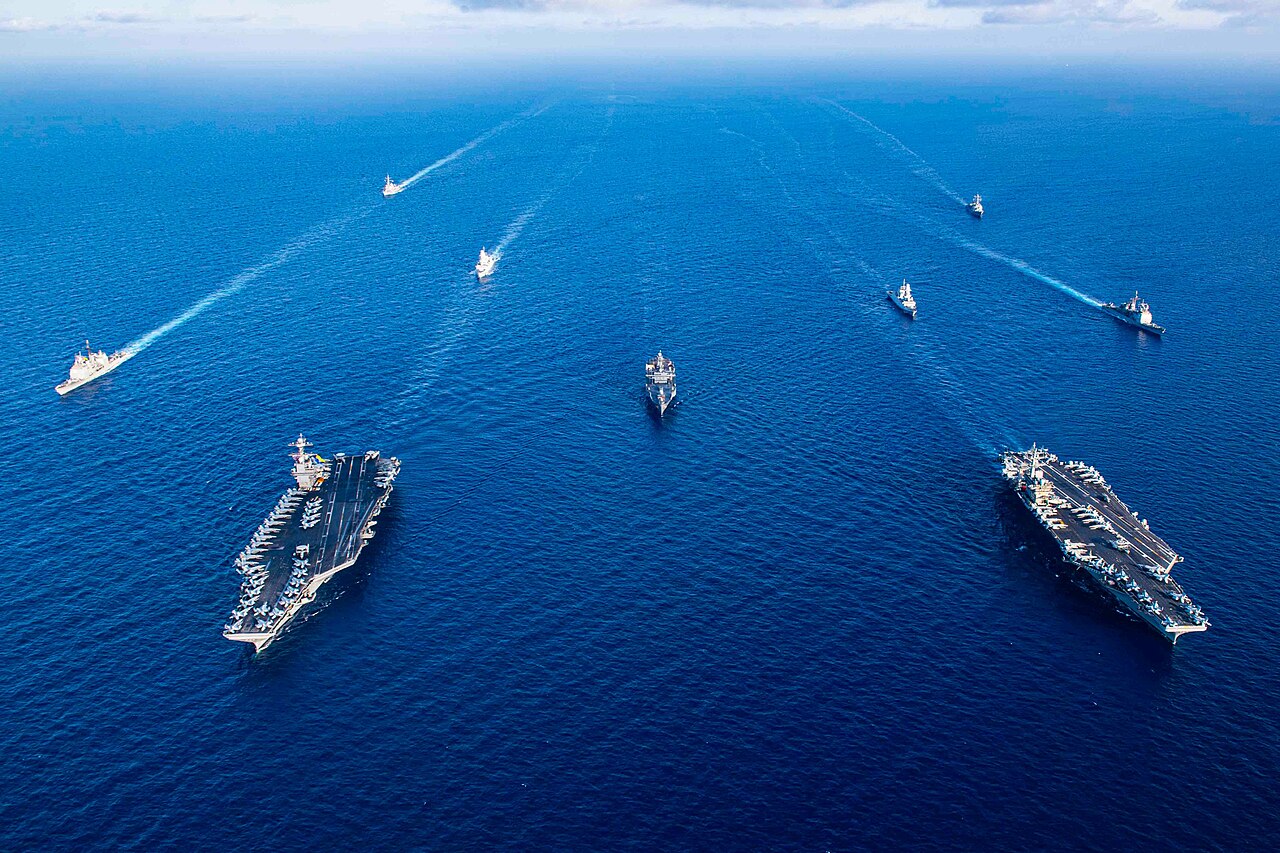
The strategic costs are significant. American naval assets — aircraft carriers, destroyers, cruisers — that would otherwise be positioned in the Indo-Pacific have been deployed to the Eastern Mediterranean and the Red Sea. The USS Eisenhower carrier strike group spent months in the region managing Houthi missile and drone attacks on Red Sea shipping. American forces have conducted strikes against Iranian proxy positions in Syria, Iraq, and Yemen, consuming munitions and generating operational tempo in a theatre that has no bearing on the balance of power in Asia.
More fundamentally, the West Asian entanglement has consumed enormous American diplomatic capital. The Biden administration spent its final year managing the Gaza crisis, attempting to broker ceasefires, managing relationships with Gulf Arab states, and responding to Iranian provocations. The Trump administration's return to a "maximum pressure" posture toward Iran has introduced new escalatory dynamics. Neither posture offers a clear path to strategic resolution — and neither posture advances American interests in Asia by a single inch.
A hegemon that allows itself to be drawn into peripheral conflicts bleeds power gradually, invisibly — until the day it discovers that the primary contest has already been decided in its absence.
Iran, it is worth noting, is not a peer competitor. It is a regional power with significant disruptive capacity but no prospect of achieving hegemony even within West Asia, let alone globally. The resources America devotes to containing Iranian influence are resources diverted from the only competition that matters strategically: the contest with China for the future of the Indo-Pacific order.
VI. The View from Beijing
Chinese strategic thinking has long emphasised patience — the capacity to pursue long-term objectives without being distracted by short-term provocations. Sun Tzu's dictum that the supreme art of war is to subdue the enemy without fighting captures something essential about how Beijing approaches its rivalry with Washington. China does not need to defeat the United States militarily. It needs to outlast American strategic attention, outbuild American regional presence, and construct facts on the ground — economic relationships, infrastructure investments, military capabilities, diplomatic alignments — that make Asian hegemony irreversible before Washington fully recognises what has happened.
Every year that the United States remains consumed by Ukraine and West Asia is a year that China continues to build its blue-water navy, deepen its economic integration with Southeast Asia through the Regional Comprehensive Economic Partnership, advance its Belt and Road infrastructure across Central and South Asia, and consolidate the military capabilities needed to credibly threaten Taiwan. The geometry of the competition is shifting — slowly, steadily, and in China's favour.
The QUAD has met. AUKUS has been signed. American security relationships with Japan, South Korea, and the Philippines have been deepened. But coalition-building of the kind that can actually deter Chinese hegemony requires sustained American strategic commitment — not periodic summits between crises in other theatres. India, in particular, remains strategically ambiguous, maintaining its tradition of strategic autonomy and declining to make the full commitment to the American-led order that Washington seeks. Deepening that relationship demands the kind of patient, sustained diplomatic investment that is extraordinarily difficult to sustain when the Secretary of State is perpetually en route to Doha or Brussels.
VII. Conclusion: The Price of Distraction
The argument of this essay is not that Ukraine or West Asia are unimportant. It is that they are being allowed to crowd out the one strategic priority that, on the logic of offensive realism, should organise all others: preventing China from achieving regional hegemony in Asia.
Mearsheimer's framework is not comfortable reading for those who prefer to believe that American foreign policy is guided by liberal values and the promotion of democracy. But its predictive power is considerable, and its prescriptions are clear. A state that has achieved regional hegemony and wishes to maintain it must above all prevent peer competitors from achieving comparable status. Everything else is secondary.
The United States is the world's most powerful state. It has the resources, the alliances, and the geographic position to prevent Chinese hegemony in Asia — if it applies those resources with strategic discipline and clarity of purpose. What it cannot do is fight proxy wars in Europe, manage escalating confrontations in West Asia, and simultaneously construct the balancing coalition in Asia that its interests demand. Strategy is the art of priority. And America, at this pivotal moment, is failing to prioritise.
History does not offer second chances to hegemons who lose their focus. The question is whether Washington will recover its strategic clarity before the window for effective action closes — or whether future historians will mark this period as the moment when the American century quietly ended, not with a bang, but with a distraction.
Notes & References
- John J. Mearsheimer, The Tragedy of Great Power Politics (New York: W.W. Norton, 2001; updated edition 2014).
- Rush Doshi, The Long Game: China's Grand Strategy to Displace American Order (Oxford University Press, 2021).
- Ashley J. Tellis, "The Geopolitics of the QUAD," Survival, Vol. 62, No. 6, 2020.
- Kiel Institute for the World Economy, Ukraine Support Tracker, 2024.
- John J. Mearsheimer, "Why the Ukraine Crisis is the West's Fault," Foreign Affairs, September/October 2014.